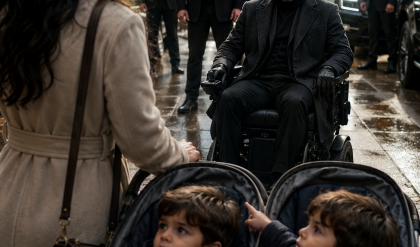
“No.”
Norah tightened her hold on the children.
Khloe looked at Declan for a long moment.
Their engagement had never been built on love.
Her family controlled one of the largest construction companies in Illinois.
Declan controlled a network that moved money, favors, and fear through half the city.
Their marriage would have turned two forms of power into one protected structure.
It had been practical.
Clean.
Emotionless.
Until the rain.
“I’m taking a cab,” Khloe said.
“I’ll call you.”
“No, you won’t.
Not tonight.”
She stepped closer to Declan, lowering her voice.
“Decide whether you are going to be a man or an empire.
Then call me.”
Khloe entered the cab Marcus had summoned and disappeared into traffic.
Norah watched her leave.
“She seems reasonable.”
“She is.”
“That makes this worse.”
Declan opened the Maybach’s door.
“No,” he said.
“It makes it honest.”
They stopped at a twenty-four-hour diner on the Near North Side because Norah refused to enter any restaurant associated with Declan.
Inside, fluorescent lights shone over cracked vinyl booths and a rotating display of pies.
Leo urgently inspected the bathroom.
Maya opened sugar packets and arranged their contents across the table with grave concentration.
Norah ordered two small orange juices and one plate of fries for the children to share.
Declan added grilled cheese, chicken strips, macaroni, fruit, and another plate of fries.
“You didn’t have to do that,” she said.
“I know.”
The children ate with an efficiency that disturbed him.
They did not complain.
They did not waste anything.
Leo ate each chicken strip from both ends toward the middle.
Maya dipped every fry into ketchup with careful precision.
Declan had grown up poor enough to recognize children who understood that food was not guaranteed.
“Where are you living?” he asked.
Norah wrapped both hands around her coffee.
“We move.”
“How often?”
“When we need to.”
“When did you last need to?”
“Three weeks ago.”
“Why?”
She looked toward the children.
“Someone recognized me in St.
Louis.
I don’t know whether he was connected to you or one of the people who hate you.
I didn’t stay long enough to ask.”
The coffee turned bitter in Declan’s mouth.
His world had continued pursuing her even after he stopped.
“Before St.
Louis?”
“Indianapolis.
Before that, Cincinnati.”
“How many places in three years?”
“Enough that Leo knows how to pack his own backpack.”
Declan looked at his son.
The boy had lined up the salt and pepper shakers, napkin dispenser, and ketchup bottle as if building a small defensive wall.
“You’re coming somewhere safe,” Declan said.
Norah’s eyes sharpened.
“No.”
“You admitted someone found you.”
“I also know what your version of safety looks like.
Men at the door.
Cameras in every room.
Windows that open three inches.
A beautiful cage is still a cage.”
“I would never lock you in.”
“You wouldn’t need to.
You would make the outside world so dangerous that staying would feel like my only choice.”
Declan had no immediate answer because she had described him accurately.
After dinner, Marcus drove them to a brick house in a quiet neighborhood north of the city.
It was owned through companies that did not visibly connect to Declan.
There were clean sheets, children’s cereal, working heat, and no armed men waiting inside.
Norah inspected every lock.
She checked the windows, back door, basement entrance, and sight lines from the street.
Declan watched without interrupting.
Three years earlier, she had been fearless in an ordinary way.
She walked home alone after dark, left her purse unattended in restaurants, and trusted that locked doors meant safety.
Now she entered rooms like he did.
Looking for exiTS.
Cataloging threaTS.
He had done that to her.
Norah put the twins together in the larger bedroom.
Maya immediately curled against Leo, one small fist clutching the back of his shirt.
At the door, Norah turned to Declan.
“I am not forgiving you.”
“I didn’t ask.”
“I’m not coming back.”
“I understand.”
“And tomorrow, we leave if I decide we leave.”
“You have my word.”
She studied him as though searching for the hidden clause.
Then she closed the bedroom door.
Downstairs, Marcus made coffee.
“Sullivan called eight times,” he said.
Sullivan Crane had served as Declan’s second-in-command for eleven years.
He never called repeatedly unless a situation was collapsing.
“What happened?”
“He wouldn’t say over an unsecured line.”
“Tell him morning.”
Marcus looked toward the ceiling.
“That may not be soon enough.”
“It will have to be.”
Declan sat alone at the kitchen table after Marcus moved to the front window.
Above him slept two children who carried his blood and knew nothing about him.
He imagined the years he had missed.
First steps.
First words.
Fevers.
Nightmares.
Birthdays.
He had spent those years acquiring warehouses, political leverage, and enough fear to make powerful men lower their voices when they spoke his name.
Meanwhile, his son had learned how to pack quickly.
His daughter had learned to study strangers before trusting them.
At 2:03 a.m., an unknown number sent Declan a message.
Four words appeared on the screen.
We know where you are.
The empire had found his children before he had even learned how they took their eggs.
Part 2
Declan woke Norah at four in the morning.
She saw the message and did not panic.
That frightened him more than panic would have.
“This is what I ran from,” she said.
“The messages in the dark.
The counting of doors.
Never knowing whether the car outside belongs to a neighbor or someone waiting for permission to kill you.”
“I know.”
“No, Declan.
You have always been the person making other people run.”
The truth landed cleanly.
They moved before dawn in a gray Volvo Marcus kept two blocks away for emergencies.
The twins slept in the back seat while Chicago passed in dark, wet fragments outside the windows.
The second house was in Evanston, rented under the name of a retired schoolteacher who did not exist.
Norah put the children on a couch beneath a blanket, then stood at the kitchen sink with both hands gripping the counter.
“Were you looking for me?” she asked.
“For three monThS.”
“And then?”
“I found proof that you left voluntarily.”
“So you stopped.”
“Yes.”
“Why?”
“Because bringing you back would have meant dragging you into the same world you escaped.”
She turned toward him.
“You made that decision for me.”
“I respected your choice.”
“No.
You decided what was best for me without asking.
Which is exactly what I did to you.”
Declan looked at her.
Two people had stolen each other’s choices and called it protection.
Norah faced the sink again.
“There is something else you should know.”
He waited.
“When I left Chicago, I wasn’t carrying twins.”
Declan went still.
“There were three babies,” she said.
“I lost one at eleven weeks.”
His breath caught.
“I was alone in Cincinnati.
I woke up bleeding in a bathroom, and I didn’t know whether I was losing all of them.
I couldn’t go to the hospital under my real name.
I had no one to call.”
“Norah—”
“I’m not telling you to punish you.
I need you to understand the price of the choice I made.”
He moved closer but did not touch her.
“I’m sorry.”
“Sorry doesn’t change the architecture.”
“No,” he said.
“But I am still sorry.”
She closed her eyes.
For several seconds, they stood side by side without touching, separated by inches and three years.
Then Declan’s phone rang.
Sullivan did not waste time.
“The Rourke crew placed three men inside our Wicker Park network,” he said.
“Someone has been embedded long enough to access shell companies and safe houses.”
“The address last night?”
“Likely compromised through the network.”
“Who had access?”
“Marcus, me, Evan Toth, and two financial managers.”
“Toth?”
Silence.
“I haven’t reached him since midnight,” Sullivan said.
Evan Toth had managed Declan’s hidden property registrations for ten years.
If he had betrayed them, every safe address was exposed.
“There’s more,” Sullivan continued.
“Marco Reyes is meeting with the Kellerman banking group.
They intend to freeze your construction accounts and force a transfer of your distribution asseTS.”
Reyes had spent six years pretending to be an ally and three years waiting for Declan to show weakness.
Now rumors of a woman and two children had traveled through Chicago faster than any official announcement could have.
“Call the network heads,” Declan said.
“Meeting tonight.”
“They already expect you.”
“Good.”
Declan ended the call.
Norah had heard everything.
“You’re leaving?”
“For several hours.”
“You promised no one from your organization would come near the children.”
“They won’t.”
“You also promised safety.”
“I am trying to preserve it.”
“No.
You are trying to preserve control.”
Declan looked toward the sleeping twins.
For the first time, the difference mattered to him.
“I will come back,” he said.
Norah’s face remained guarded.
“That is what powerful men always say before they choose power.”
The meeting took place above a closed restaurant in River North.
Ten men sat around a long table.
Most had known Declan for years.
Some had lied for him, stolen for him, and ordered violence in his name.
They watched him more closely than usual.
Marco Reyes sat near the opposite end, wearing a navy suit and a satisfied expression.
“You look tired,” Reyes said.
“I am touched by your concern.”
“The city is concerned.
A man disappears from his schedule, abandons his fiancée in the rain, moves between safe properties, and suddenly shuts down half his network.”
“Who told you I moved properties?”
The room became quiet.
Reyes smiled.
“People notice things.”
Declan’s gaze shifted to Evan Toth’s empty chair.
During the operational discussion, Reyes checked his phone immediately after Sullivan mentioned the first compromised house.
It was a tiny reaction.
Enough.
“Walk with me,” Declan said.
In the hallway, Reyes leaned against the wall.
“You found something personal,” he said.
“A woman, from what I hear.
Children, perhaps.”
Declan gave no reaction.
Reyes’s smile widened.
“That is the danger of loving something.
Men begin believing you can be negotiated with.”
“Is that what you believe?”
“I believe every man has a price.
Yours simply arrived late.”
Declan stepped closer.
“If anyone approaches those children, there will be no organization left for you to inherit.”
“That sounds like fear.”
“It is information.”
Declan left without touching him.
At the private elevator, Khloe was waiting.
She wore black now, with no engagement ring.
“How did you know I was here?” he asked.
“My family helped finance this building.”
“Of course.”
She handed him a slim folder.
Inside were account numbers, meeting schedules, and a draft agreement between Hartwell Consolidated, the Kellerman group, and companies controlled by Reyes.
“My father decided your distraction created an opportunity,” Khloe said.
“You are giving me evidence against your family.”
“I am giving you evidence against my father.
Those are not the same thing.”
“What do you want?”
“To stop pretending our engagement still exisTS.”
“It ended when I opened the car door.”
“Yes.”
Her honesty made the moment easier and more painful.
Khloe glanced at the folder.
“My father believes he can help Reyes take your legitimate assets and then remove Reyes when he becomes inconvenient.
He also believes the mother of your children can be pressured.”
Declan’s face changed.
Khloe noticed.
“There,” she said softly.
“That is why I brought this.
Not because I love you.
I don’t.
But I will not watch my family use two children as leverage.”
“You could lose everything.”
“Not everything.
Just the things my father controls.”
She stepped into the elevator, then looked back.
“You asked me once why I never wanted children.”
“I remember.”
“I told you it was because children make women vulnerable.
That wasn’t true.
I was afraid they would make me brave.”
The doors closed.
When Declan returned to Evanston, Leo was asleep in his frog booTS. Maya lay curled against Norah on the couch.
Norah studied the folder from Khloe.
“You could expose all of them,” she said.
“Reyes.
Toth.
The banks.
The Hartwells.”
“Yes.”
“And yourself?”
“Yes.”
“What would happen?”
“The organization would collapse.
Accounts would be frozen.
Properties seized.
People would be arrested.”
“Including you.”
“Possibly.”
She searched his face.
“What would remain?”
“Some legitimate property.
Cash that can be documented.
Information.”
“What kind of information?”
“The kind that makes me the most dangerous person in any room.”
Norah slowly set down the folder.
“You could burn the entire structure.”
“Yes.”
“Then do it.”
The words hung between them.
“You understand what you are asking?”
“I am not asking for revenge.
I am asking whether Leo and Maya will spend their childhood moving from one locked house to another because their father cannot release an empire he claims he built to survive.”
Declan looked at Maya sleeping against her mother.
Three days earlier, he would have sacrificed almost anything to preserve the organization.
Now his daughter’s hand was curled around Norah’s sleeve.
“What would you trade?” Norah asked.
“Your money?”
“Yes.”
“Your name?”
“Yes.”
“Your freedom?”
He paused.
“If that is the cost.”
Her eyes filled, but no tears fell.
“You would do that for children you met yesterday?”
“They were mine before I met them.”
Declan opened his encrypted phone.
Eighteen months earlier, a federal contact had offered him a cooperation agreement if he ever chose to dismantle the networks he knew.
Declan had kept the number as insurance.
Now he called it.
“I am ready to give you everything,” he said when the woman answered.
“But I have three conditions.”
“Name them.”
“Immediate protection for Norah Vale and her children.
No use of their identities in open filings.
And a civilian cooperation arrangement that allows me to remain available to them unless a court orders otherwise.”
“We can guarantee two.”
“Then find someone who can guarantee three.”
“Mr. Voss—”
“What I possess will dismantle four criminal networks and expose thirty years of financial corruption.
You have one hour.”
He ended the call.
Norah stared at him.
“There is no going back.”
“No.”
“Are you afraid?”
Declan looked at the sleeping children.
“Yes.”
It was the first time she had ever heard him admit it.
The agreement came fifty-three minutes later.
All three conditions were provisionally approved.
Declan began writing names, dates, companies, account numbers, and routes from memory.
For two hours, his pen moved steadily across a yellow legal pad.
At 1:18 a.m., Sullivan called.
“Two vehicles are outside the first house.
Reyes’s people.
Someone is giving them live information.”
“Prepare every exit route Reyes might use.”
“You want him stopped?”
“I want him to understand that surrender is his only route.”
At 1:40, Marcus drove them toward a house in Indiana that Declan had bought under his legal name five years earlier.
Toth had mapped hidden properties, not obvious ones.
The children slept through the trip.
At 2:47 a.m., federal agents froze the Kellerman accounTS.
At 3:02, Declan’s phone rang from a blocked number.
A man spoke for Reyes.
“Marco wants forty-eight hours to leave the country.”
“No.”
“He has people positioned near your current location.”
Declan’s hand tightened around the phone.
Norah saw his knuckles turn white.
“What happens if I refuse?” he asked.
 Woman Colors Her Daughter’s Hair, Then Her Ex Uses The Argument To Reignite Old Battles
“The men outside receive new instructions.”
Declan ended the call.
“There are three options,” he told Norah.
“I give Reyes time to escape.
I call federal protection and wait forty-five minutes.
Or I call Sullivan and use the people I still control.”
“Which is fastest?”
“Sullivan.”
“Which is right?”
Declan looked at her.
“Tonight, I don’t know whether those are the same answer.”
Headlights appeared at the end of the Indiana street fifteen minutes after Sullivan received the call.
Three vehicles moved slowly toward the house.
Norah stood beside Declan at the living room window.
Upstairs, Leo and Maya slept.
Declan called Sullivan.
“Tell the men outside that anyone who leaves within five minutes will not appear in the documents I submit tomorrow.”
“You’re giving them mercy?”
“I am giving them a choice.”
Two minutes passed.
The first vehicle pulled away.
Twenty seconds later, the second followed.
The third remained.
Sullivan spoke through the phone.
“That one is ours.
My men will hold the street until federal protection arrives.”
Declan released one controlled breath.
Norah turned toward him.
“When all of this is gone,” she asked, “what are you?”
Declan looked around the ordinary living room of a house he had purchased but never lived in.
“I don’t know yet.”
She waited.
“But I know what I am not.”
Outside, the first pale line of dawn appeared over the trees as Declan Voss’s empire began collapsing one account at a time.
Part 3
By six in the morning, federal agents had entered twelve properties across Illinois, Indiana, and Wisconsin.
Evan Toth was arrested in a hotel near O’Hare with two passports and eight hundred thousand dollars in cash.
The Kellerman banking group’s private accounts were frozen.
Three Hartwell executives were taken into custody.
Marco Reyes reached a small private airfield outside Joliet and discovered that his pilot had disappeared, his fuel account had been suspended, and federal vehicles were blocking both exiTS.
Sullivan had closed every other door.
Reyes called Declan from the runway.
“You destroyed twenty years of work for a woman who ran from you.”
“No,” Declan said.
“I destroyed it for two children who should never have to.”
“You think this makes you a father?”
“No.
What I do tomorrow might.”
Reyes was arrested seventeen minutes later.
At nine, attorney Rebecca Carver arrived at the Indiana house with two federal agenTS. Declan gave them three folders, the legal pad, encrypted drives, and Khloe’s documenTS.
The agents spent seven hours questioning him at the dining-room table.
Norah remained upstairs with the children.
Declan disclosed every company he controlled, every official he had bribed, every false invoice, every illegal shipment, and every agreement used to hide money.
He did not attempt to make himself sound innocent.
When Agent Mara Ellison asked whether he understood that cooperation was not absolution, he answered without hesitation.
“Yes.”
“You will lose most of your asseTS.”
“Yes.”
“You may face home confinement, supervised release, financial penalties, and future testimony.”
“Yes.”
“Why are you doing this now?”
A crash came from the living room.
Leo had knocked over a wooden toy box Marcus found in the basement.
Declan looked toward the sound.
“Because yesterday, I learned what my success cost people who never agreed to pay for it.”
At sunset, the questioning stopped.
Declan found Norah in the backyard.
Maya sat in an old plastic swing.
Leo was investigating the fence with a stick.
“What happens now?” Norah asked.
“I cooperate.
The court decides the penalty.”
“And us?”
“You choose.”
Her expression tightened.
“You don’t get to make me responsible for whether you survive this.”
“I’m not.”
“Then what are you saying?”
“I am saying you owe me nothing.
Not forgiveness.
Not love.
Not a family because I surrendered something I should never have built.”
Norah studied him.
“You really believe that?”
“I am trying to.”
Maya pointed at Declan.
“Push.”
He approached the swing awkwardly.
“How hard?”
Norah almost smiled.
“She’s two, Declan.
Not entering orbit.”
He gave the swing a gentle push.
Maya moved forward, then back.
Her serious expression did not change.
“Again,” she said.
He pushed again.
For twenty minutes, the man who had once controlled hundreds of people followed the instructions of a little girl who knew only one word she needed him to understand.
Again.
Three days later, the story reached every news station in Chicago.
The reports called Declan a criminal informant, a syndicate leader, a disgraced businessman, and the architect of the largest organized-crime disclosure in the region in more than a decade.
They called Khloe Hartwell a cooperating witness after she provided additional records against her father.
They called Sullivan Crane a former lieutenant who surrendered voluntarily.
They called Norah nothing.
Declan had insisted that her name and the twins’ identities remain sealed.
Khloe sent one handwritten note to the Indiana house.
For the first time, you chose people over architecture.
Do not waste it.
Declan never saw her again.
Her testimony helped convict her father, but she was not charged.
She sold her shares in Hartwell Consolidated and established a legal construction company in Seattle under her mother’s maiden name.
Sullivan received a reduced sentence after providing evidence against Reyes and Toth.
Before reporting to federal custody, he visited Declan.
They stood on the back porch while the twins played in the yard.
“You know,” Sullivan said, “I spent eleven years believing I was loyal to you.”
“You were.”
“No.
I was loyal to the machine.
I withheld information because I thought protecting the structure was the same as protecting you.”
Declan watched Leo push a toy truck through the grass.
“I made the same mistake for twenty years.”
Sullivan nodded toward the children.
“They’re loud.”
“Yes.”
“And small.”
“I noticed.”
“You have no idea what you’re doing.”
“None.”
For the first time in eleven years, Sullivan laughed in Declan’s presence.
Then he shook Declan’s hand and left to serve thirty months in a federal facility.
Declan’s own hearing occurred six weeks later.
The courtroom was packed with reporters, attorneys, former associates, and families affected by the organizations his evidence dismantled.
The judge described his cooperation as extraordinary.
Then she described his crimes as deliberate.
“You do not receive a new life because you performed one good act,” she said.
“You receive the opportunity to build a different life because your cooperation prevented further harm.
What you build is now your responsibility.”
Declan pleaded guilty to financial conspiracy, unlawful enterprise activity, and obstruction.
He forfeited most of his properties and accounTS. Millions were placed into restitution funds.
He received eighteen months of home confinement, five years of supervised release, and permanent restrictions on several business activities.
It was more mercy than many believed he deserved.
It was less freedom than he had once possessed.
It was the first consequence he had accepted without attempting to negotiate around it.
Norah rented a small house three blocks away.
She did not move in with Declan.
She did not resume their relationship.
She did not allow his sacrifice to become a shortcut around the damage between them.
But every morning, she brought Leo and Maya to the Indiana house.
At first, she remained during every visit.
Declan learned to make scrambled eggs without burning them.
He learned which cup belonged to which child.
Leo wanted the blue cup on Mondays and the green cup every other day, except when he suddenly wanted neither.
Maya refused bananas if they were sliced too thick.
Both children hated having their hair washed.
Neither cared that their father had once been feared across Chicago.
To them, he was simply the man who made uneven pancakes and read the same book four times because Maya kept saying again.
The ankle monitor irritated him.
The scheduled calls with federal supervisors annoyed him.
The reporters outside the property angered him.
Yet the most difficult thing was not losing power.
It was learning not to replace it with control.
When Leo developed a fever one winter night, Declan tried to summon a private physician, arrange an armored vehicle, and call three security contacTS.
Norah took the phone from him.
“We are going to urgent care.”
“That waiting room is exposed.”
“It is also where normal parents take children with fevers.”
“I can make it safer.”
“Declan.”
He stopped.
“You are not protecting him,” she said.
“You are feeding your fear.”
He looked at Leo asleep against his chest.
Then he put on an ordinary coat, entered Norah’s ten-year-old SUV, and sat in a public waiting room beneath fluorescent lights for ninety minutes.
No one attacked them.
No one recognized them.
The doctor diagnosed an ear infection.
On the drive home, Leo woke and whispered, “Daddy stay?”
The word nearly stopped Declan’s heart.
Norah heard it.
She kept her eyes on the road.
Declan looked down at his son.
“I’m staying.”
After the children were asleep, Norah stood in Declan’s kitchen.
“He called you Daddy.”
“I heard.”
“You don’t have to look terrified.”
“I have been called many things.
That one has requiremenTS.”
“Yes.”
“I don’t know whether I deserve it.”
“Children don’t ask whether we deserve to be their parenTS. They ask whether we show up.”
She reached for her coat.
“Norah.”
She paused.
“I loved you,” he said.
“I never stopped.”
Her face softened, but she did not move closer.
“I know.”
“I am not asking you to say it back.”
“Good.
Because love was never our problem.”
“What was?”
“We loved each other and still believed that gave us permission to make choices for the other person.”
Declan nodded.
“I won’t do that again.”
“You probably will.
People repeat themselves.”
“Then tell me when I do.”
“I always did.”
“I didn’t listen.”
“No.”
He accepted that.
At the door, she looked back.
“I don’t trust promises anymore, Declan.”
“What do you trust?”
“Patterns.”
Then she left.
So Declan built one.
He arrived when he said he would.
He completed every federal interview.
He attended parenting classes without telling anyone they were unnecessary.
He apologized when he was wrong.
He stopped asking Marcus to follow Norah’s car.
He gave Norah access to every account related to the children and no authority over hers.
He never entered her house without being invited.
When he disagreed with her, he spoke instead of issuing instructions.
Weeks became monThS.
Maya stopped studying him before climbing into his arms.
Leo began saving the chair beside him at breakfast.
Norah began leaving the children for an hour, then an afternoon, then occasionally overnight.
Ten months after the rain, she joined Declan on the back steps while the twins played.
Their shoulders touched.
Neither moved away.
“You’re different,” she said.
“I’m monitored by three federal agencies.
It encourages discipline.”
She laughed.
The sound reached a part of him that had remained locked for years.
“I don’t mean that.”
“I know.”
“I still remember the garage,” she said.
“I still wake up expecting someone to be outside.”
“I know.”
“And I don’t know whether that ever disappears.”
“It doesn’t have to disappear for me to be sorry.”
She studied him.
“The old Declan would have promised to make it disappear.”
“The old Declan believed every problem was something he could remove.”
“And this Declan?”
“He understands that some damage must be carried carefully.”
Norah looked toward Maya, who was trying to convince Leo that leaves belonged inside his jacket.
“I might love you again,” she said.
Declan’s breath stopped.
“Or maybe I never stopped.
I don’t know.”
He waited.
“But I will not return to what we were.”
“Neither will I.”
“What are you asking for?”
“Breakfast tomorrow.”
“That’s all?”
“Tomorrow is the only thing I have the right to ask for.”
She nodded.
“Breakfast, then.”
Eighteen months after Declan stepped out of the Maybach, a federal officer removed the monitor from his ankle.
He remained under supervision, but the house was no longer a boundary.
The first place he went was not Chicago.
It was Norah’s front porch.
She opened the door wearing jeans, a gray sweater, and an expression that suggested she had expected him.
The twins raced past her.
Leo wrapped himself around Declan’s leg.
Maya lifted both arms.
“Up.”
Declan picked her up.
Norah leaned against the doorway.
“You’re free,” she said.
“Not entirely.”
“No one is.”
He looked at her.
“I don’t want the empire back.”
“I know.”
“I don’t want the old house, the cars, the meetings, or the version of me who believed fear was respect.”
“I know.”
“I want mornings.
I want ear infections.
I want arguments about cups.
I want to know what Leo builds when he is ten and what Maya refuses to tolerate when she is sixteen.”
Maya rested her head on his shoulder.
Declan continued.
“And I want you.
But only if choosing me does not require losing yourself.”
Norah’s eyes filled.
“You finally learned how to ask.”
“Is that a yes?”
“It is a beginning.”
Two years after the night in the rain, Declan and Norah married in the backyard of the Indiana house.
There were twelve guesTS.
Marcus stood beside Declan.
Khloe sent white roses without a card.
Sullivan attended by video from a federal reentry center and complained about the camera angle.
Leo carried the rings in the pocket of his yellow frog raincoat, which was now far too small but which he refused to surrender.
Maya scattered flower petals with the solemn focus of a person performing an important government duty.
Declan made no grand vows.
He promised to tell the truth.
To ask instead of command.
To protect without imprisoning.
To stay when staying was difficult.
Norah promised no easy forgiveness and no perfect future.
She promised honesty, choice, and the courage to leave any room where love began resembling a cage.
Then she chose to remain.
After the ceremony, rain began falling lightly over the backyard.
Leo ran through it.
Maya climbed onto the old swing and looked at Declan.
“Daddy.”
“Yes?”
“Again.”
Declan placed both hands behind her and pushed.
She swung forward, laughing as rain collected in her dark hair.
Norah stood beneath the porch roof, watching him with the quiet expression of a woman who no longer needed to calculate the nearest exit.
Declan pushed his daughter again.
Once, his power had been measured by how many people obeyed when he entered a room.
Now it was measured by something smaller and infinitely harder.
A son who expected him at breakfast.
A daughter who trusted his hands.
A woman who stayed because every door remained open.
And the knowledge that when the moment came to choose between his empire and his children, Declan Voss had finally understood which one made him rich.
THE END