PART 1
The stuffed rabbit hit the pavement and rolled to a stop beneath the front wheel of Adrian Volkov’s chair.
Six armed men froze mid-step.
Two black SUVs idled along the Milwaukee RiverWalk, and pedestrians drifted sideways without quite knowing why, the way a crowd senses a drop in temperature before anyone names it cold.
Adrian sat at the center of it all in a charcoal overcoat, one gloved hand resting near the controls of a custom carbon-fiber wheelchair.
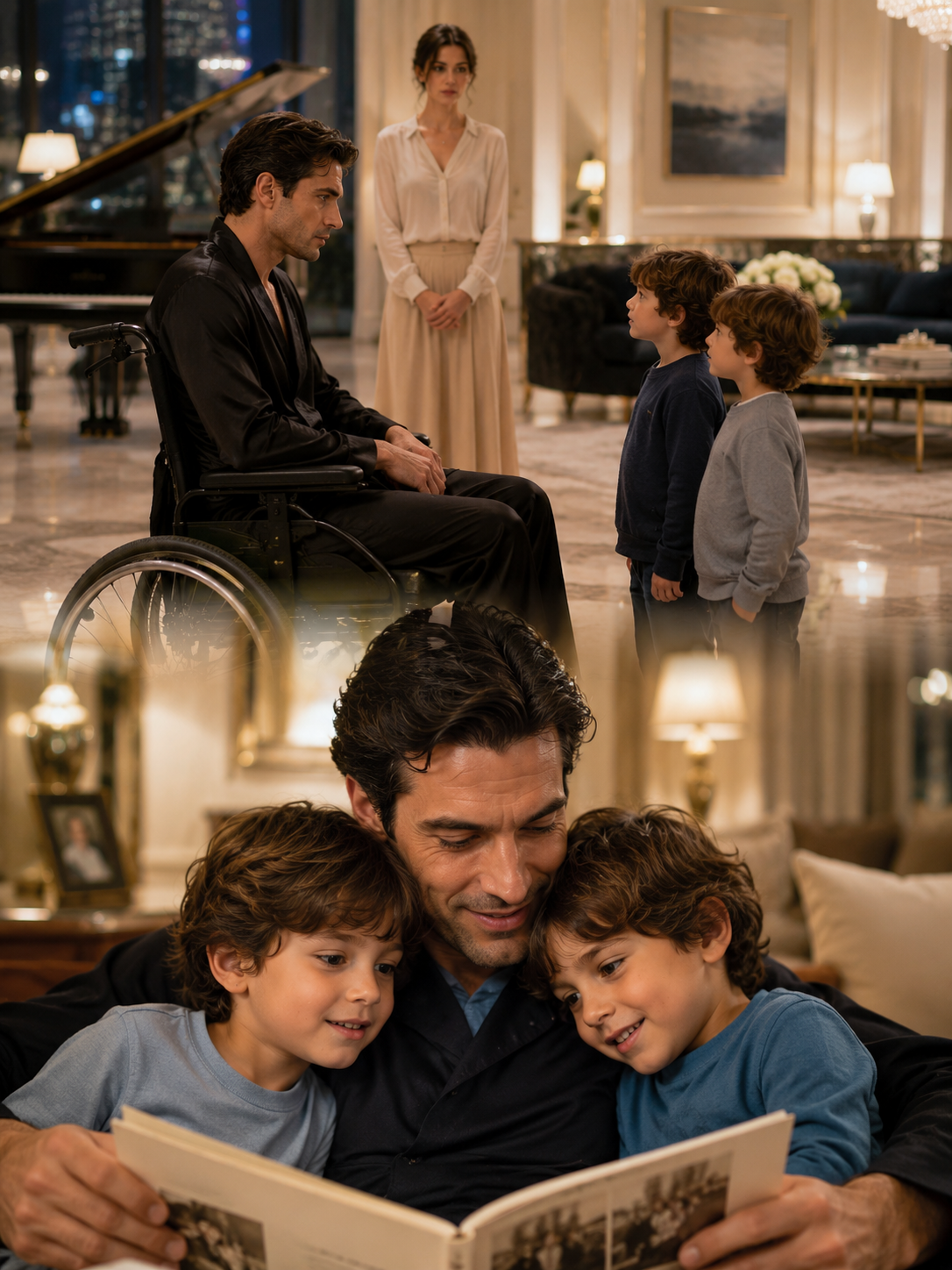
Three years earlier, a bullet had taken the use of everything below his waist.
According to four separate specialists, it had also taken away any real chance of ever becoming a father.
Then he looked up.
A woman stood twenty feet away, one hand wrapped around the handle of a double stroller.
Naomi Delgado.
The only woman he had ever loved.
The woman he had personally driven out of his hospital room.
The woman who had vanished before sunrise, leaving no forwarding address, no new number, no explanation at all.
Her face drained white the instant she saw him.
Adrian’s eyes dropped to the stroller.
Two little boys stared back up at him — both with Naomi’s dark hair and warm coloring, both with his own sharp jaw, and both with the same rare, silver-gray eyes that had made grown men lower their voices around him since he was twenty years old.
One of the boys pointed straight at the wheelchair.
“Cool chair.”
Adrian forgot, for a full second, how breathing worked.
Beside him, his security chief Gabriel Cross followed his gaze and murmured, “Dear God.”
Naomi stepped in front of the stroller — a reflex, a mother’s body angling itself between her children and a threat.
Between her children and him.
The realization hit Adrian harder than the bullet ever had.
“How old are they?” His voice came out quiet.
Naomi flinched anyway, as though he’d shouted it.
“Adrian—”
“How old.”
Around them, pedestrians kept moving, oblivious that the most powerful criminal figure on the Great Lakes had just watched his entire understanding of his own life come apart on a public sidewalk.
Naomi’s eyes filled with fear, then anger, then something worse — grief.
“They turned three in April.”
The world went completely silent around him.
He’d been shot three years and six months ago.
He’d sent Naomi away three years and five months ago.
The math assembled itself in his head with brutal, immediate precision.
He looked at the boys again.
The more serious of the two clutched the rabbit against his chest, watching Adrian with open suspicion.
The other leaned forward against the stroller strap, studying him like a puzzle he fully intended to solve.
Adrian had survived assassination attempts, federal subpoenas, betrayals from men he’d trusted with his life, and a father who’d taught him that affection made men weak.
He had no defense whatsoever against two small children wearing his own face.
“Are they mine?”
Naomi swallowed hard and said nothing.
She didn’t need to.
*
Three years before that morning, Adrian Volkov had believed he was performing the single most selfless act of his life.
He’d been badly wrong.
Before the bullet, he’d run Chicago’s waterfront out of a glass office overlooking the lake.
Volkov Maritime Group looked airtight on paper — freight terminals, warehouses, trucking, a handful of luxury developments, quarterly reports clean enough to impress investors and complicated enough to discourage anyone from digging further.
Underneath all of it sat another architecture entirely, built out of favors, leverage, and money routed through more accounts than any single auditor could reasonably trace.
He’d inherited the whole structure at twenty-nine, the night his father collapsed at the dinner table.
By thirty-four he’d turned it into something colder and far more disciplined than his father had ever managed — no shouting, no repeated threats, no unnecessary violence, because unnecessary violence drew police attention and police attention was bad for business.
Most men feared him for what they’d seen him do.
The smart ones feared him for what they understood he was capable of doing without feeling a single thing about it.
Naomi walked into his life because she found forty-two million dollars that was never supposed to exist.
She’d been a forensic accountant at a respected Chicago firm, assigned to review the books of a small real estate company tied to one of Adrian’s shell corporations.
Her supervisor expected a rubber stamp.
Instead, buried under seventeen years of transfers, Naomi found a pattern, and she reported it exactly as her training told her to.
Her terrified supervisor called Adrian directly.
At quarter past ten that night, Adrian walked into her office with Gabriel and two more men trailing behind him.
Naomi sat behind her desk eating sliced apples out of a plastic container, and she took in his suit, his guards, and his expression with the mild curiosity of someone assessing weather, not danger.
“You must be the reason my boss is sweating through his shirt,” she said.
He’d come prepared to offer her money, and if that failed, to let Gabriel handle the persuading.
No one had ever looked at Adrian Volkov with that complete an absence of fear.
“You found a discrepancy,” he said.
“I found a laundering system.”
The guards shifted their weight.
Naomi calmly ate another apple slice.
“You understand that accusing a client of criminal activity is a serious matter.”
“I’m not accusing you of anything.
I’m describing the math.”
She turned her monitor to face him and spent the next ten minutes walking him through exactly how the money moved, where it grew vulnerable, and how a federal auditor would eventually find every seam in it.
She didn’t moralize.
She didn’t tremble.
She just told him the truth as plainly as she’d tell anyone.
“Why are you helping me?” he finally asked.
“I’m not.
I’m showing you your system isn’t half as clean as you think it is.”
No one had spoken to him like that since his mother died.
He should have destroyed her career on the spot.
Instead, he asked her to dinner.
She said no.
He asked again two days later.
She said no again.
The third time, he sent no driver, no flowers, no expensive gift — just showed up outside her office alone, holding two cups of coffee.
She glanced at the accessible ramp on the building, then at him standing tall and visibly impatient by the curb.
“Where’d the bodyguards go?”
“They made you uncomfortable.”
“You make me uncomfortable.”
“I can’t very well dismiss myself.”
She laughed despite clearly trying not to, and that sound rearranged something in him permanently.
Everything after that built slowly, and then all at once.
Naomi never pretended he was an innocent businessman misunderstood by the world, and he never insulted her by acting like it either.
She pushed back constantly — on the people he surrounded himself with, on decisions he called necessary, on walls he’d mistaken for strength his entire life.
Adrian didn’t listen to anyone.
He listened to her.
Within six months he’d started quietly separating his legitimate companies from the rest of the organization, calling it a financial strategy.
Gabriel knew better.
Naomi was teaching him to imagine a life that didn’t require locked gates and armored cars, and once a man starts imagining that, it’s difficult to stop.
He proposed in a hotel suite on a gray March morning, sliding an emerald ring across the table between them.
Naomi stared at it.
“That stone is ridiculous.”
“Fourteen caraTS.”
“That doesn’t improve the argument.”
“I could exchange it.”
“For something smaller?”
PART 2
“For something larger.”
She laughed and shook her head.
He reached across and took her hand, and the powerful man vanished from his own face, leaving behind someone who had never once, in his entire life, asked for anything that actually mattered to him.
“Marry me, Naomi.”
She studied him for a long moment, then slid the ring onto her finger.
“Yes.”
The ambush came six weeks later.
Someone inside his own organization had sold his route, his rotation, his travel schedule to a rival crew run by Renzo Castillo.
The attack hit beneath the concrete tunnels off Lower Wacker.
The first bullet caught his shoulder.
The second went into his lower back.
He remembered the sound of tearing metal, Gabriel hauling him out of the vehicle, blood soaking straight through his shirt — and then nothing.
He woke eleven days later in a private wing near Streeterville, Naomi’s hand wrapped around his, her hair unwashed and her eyes swollen from crying.
When she saw him wake, she pressed his fingers to her lips.
“You came back,” she whispered.
He tried to move his legs.
Nothing answered.
The neurosurgeon used the phrase complete motor paralysis and the word permanent.
He also mentioned, almost as an afterthought, that the nerve damage made natural conception almost certainly impossible — less than a fraction of one percent, he said.
Adrian heard exactly one sentence in the entire conversation: he could not give Naomi the life she deserved.
That afternoon he had Gabriel pull the engagement ring from the hospital safe.
When Naomi walked back in, he was staring at the wall.
“You need to leave,” he said.
She stopped beside the bed.
“What?”
“Our engagement is over.”
She thought, at first, it was the medication talking.
Then she saw how deliberate the coldness in his face actually was.
“You just woke up.
You’re scared and you’re angry.
You don’t get to decide this today.”
“I already decided.”
“We made a promise.”
“You made that promise to a man who could walk.”
“I made it to you.”
“You wanted children.”
“We never decided anything about children.”
“You wanted a family.”
“You are my family.”
His jaw locked.
He’d already survived an unbearable amount of pain that day.
Her love, he’d decided, was the one kind he couldn’t survive.
“You don’t understand what my life is going to be.”
“Then explain it to me.”
“I’ll need help for everything.”
“We’ll hire help.”
“I may never stand next to you again.”
“Then sit next to me.”
“I can’t give you children.”
Something shifted in her expression — not because the fact itself mattered to her, but because she finally understood exactly where the cruelty was coming from.
She leaned in close.
“I don’t care.”
“You will.”
“No, Adrian.
You care.
You’re deciding what my whole future should look like because you’re too proud to let me choose it myself.”
His voice went colder than she’d ever heard it.
“I don’t love you anymore.”
The lie nearly killed them both on the spot.
She stared at him.
He turned toward the wall.
She begged him to look at her, and he refused.
Finally she slid the ring off with shaking fingers and set it on the bedside table.
“I would have stayed,” she whispered.
“Whatever happened to you, I would have stayed.”
He said nothing until Gabriel walked her out.
She was gone the next morning.
He told himself she’d thank him eventually.
That she’d meet a decent man, build a safe life, have the children she’d always deserved.
He told himself he had set her free.
Three weeks later, Naomi sat alone in a women’s clinic holding three positive pregnancy tesTS. The doctor put her at seven weeks.
The follow-up ultrasound found two heartbeaTS.
She walked out under a bright Chicago sky and sat in her car for almost an hour, her first instinct to call him — and then she pictured exactly what would follow.
Adrian would claim the children instantly.
He’d surround them with guards before they could walk.
They’d grow up behind gates, carrying a last name that made them targets before they’d even learned to read.
She’d seen the wives and children who lived inside his world — mansions, armored cars, and not one of them free.
She put a hand over her stomach.
Her children hadn’t chosen that world.
She wasn’t going to let it choose them either.
Within a week she’d resigned from her firm, broken her lease, changed her number, and moved to Milwaukee — a remote accounting job with a nonprofit housing organization, a modest two-bedroom townhouse near the lake.
She painted the nursery pale gray, told herself the color had nothing to do with the exact shade of Adrian’s eyes, and knew it was a lie the moment she set the brush down.
On a stormy April night, she gave birth to two boys seventeen minutes apart and named them Leo and Theo Delgado.
Leo turned out bold, impatient, convinced every closed door existed purely to be opened.
Theo turned out quiet, watchful, capable of studying a person until they confessed something nobody had asked them for.
Both of them had Adrian’s eyes.
For three years Naomi built a life out of exhaustion, discipline, and a love so total it frightened her some nighTS. She worked through naptimes and after bedtime, learned to carry two sleeping toddlers at once, stretched every paycheck further than it wanted to go, leaned on her mother, and got very good at surviving on four hours of sleep.
She never once spoke badly about their father.
When Leo asked why other kids at the playground had dads and he didn’t, she chose her words carefully.
“Your father is someone I loved very much.”
“Does he know me?”
“No.”
“Why not?”
“Because grown-ups sometimes make complicated choices when they’re scared.”
“Is he scared of me?”
She kissed his forehead.
“No one could be scared of you.”
Theo looked up from his toy cars without missing a beat.
“People can be scared of Leo.”
Naomi laughed so hard she cried.
She’d believed, right up until that morning on the RiverWalk, that she had actually managed to protect them.
A trusted colleague at the nonprofit referred her to a company planning an affordable housing project along the river — Harbor View Development — and she took the meeting without ever checking who owned it.
Had she looked closer, she’d have found it sitting quietly under Volkov Maritime Group’s umbrella.
She’d brought the boys because the sitter had canceled that morning.
Theo threw his rabbit.
Adrian’s convoy stopped.
And three years of carefully built distance disappeared in a single second.
*
Back on the RiverWalk, Adrian looked at Naomi like he was staring at both a miracle and a betrayal at once.
“You kept my children from me.”
Her hands tightened on the stroller.
“You threw me out of your life.”
“I didn’t know.”
“You made absolutely sure I couldn’t tell you.”
His men held their distance, watching.
He lowered his voice.
“We are not doing this here.”
“There is no we.”
“There are two boys standing between us with my face.
There is a we whether you want one or not.”
Her fear sharpened into anger.
“You don’t get to see them and immediately try to take control.”
“I’m not asking for control.”
“You’ve never asked for anything in your life.”
That landed harder than she probably intended.
Leo leaned toward his brother and stage-whispered, “Mom knows the chair man.”
Theo nodded gravely.
“The chair man looks mad.”
“I’m not mad at you,” Adrian said.
Both boys stared at him with matching skepticism.
Leo pointed at his gloves.
“Are you a race car driver?”
“No.”
“Did you crash?”
“Something like that.”
Naomi closed her eyes briefly.
Adrian reached into his coat, handed Gabriel a card, and Gabriel passed it forward.
“My private number,” Adrian said.
“No assistant.
No tracking.
No one shows up at your door.”
“You expect me to believe that?”
“No.
I expect you to call because someday those boys are going to ask whether you ever gave me the chance to know them.”
Her expression tightened.
He’d found the one argument she couldn’t wave off.
She took the card, then pushed the stroller past him without another word, and he watched his sons vanish into the crowd.
Only once they were gone did Gabriel step closer.
“Dom?”
Adrian kept staring at the empty walkway.
“Find out who took photographs.”
“You saw someone?”
“I saw three phones pointed at us.”
“Tourists, maybe.”
“Maybe.”
“And if they weren’t?”
Adrian looked toward the river.
For the first time in three years, real fear entered his voice.
“Then my enemies just found out I have sons.”
PART 3
Naomi didn’t call him that night.
She locked every door twice, checked every window, and sat between Leo’s and Theo’s beds until both boys finally fell asleep.
At eleven-thirty her mother called.
“You sound frightened,” Carmen Delgado said.
“I saw him.”
Silence, then: “Adrian?”
“He saw the boys.”
Carmen exhaled slowly.
Naomi had never lied to her about the twins’ father — Carmen had supported her leaving Chicago, though she’d always warned that secrets carried interest.
“What did he do?”
“He looked at them.”
“That’s all?”
“You didn’t see his face.”
“Was he angry?”
“Yes.
No.
I don’t know.”
“Did he threaten you?”
“No.”
“Then maybe you should talk to him.”
Naomi got up and started pacing.
“You know what his world is.”
“I also know what it means to raise children who ask questions you can’t answer forever.”
“They’re three.”
“They won’t stay three.”
At midnight, Naomi took the card from her purse and stared at the number.
Before she could dial it, her phone rang first.
Unknown caller.
Her heart stopped.
She answered without speaking.
A man’s voice said, “Beautiful children,” and hung up.
She called Adrian immediately.
He picked up before the first ring finished.
“Where are you?”
“Home.”
“Doors locked?”
“Yes.”
“Take the boys to the basement.”
“What’s happening?”
“A Castillo surveillance team photographed us on the RiverWalk.”
Her knees nearly gave out.
“Who just called me?”
“We don’t know yet.”
“You said no one would come to my house.”
“I lied.”
She heard car doors slam through the phone, men shouting somewhere behind him, rage exploding through her all at once.
“You promised me.”
“I promised that when I thought I had time.
I no longer have time.”
Headlights swept across her front windows.
She ran upstairs.
“Leo.
Theo.
Up, now.”
Leo sat bolt upright.
“Is it morning?”
“No, sweetheart.
We’re playing a quiet game.”
Theo clutched his rabbit and said nothing.
The doorbell rang.
Naomi checked the camera — Gabriel on the porch beside a woman in a dark suit, Adrian still on the line.
“Special Agent Priya Nash,” he said.
“She’s worked federal security with my attorney for years.
She’ll show you identification.”
“You brought a federal agent into this?”
“I brought someone whose loyalty I can actually verify.”
Naomi opened the door only after examining the badge herself.
Six minutes later the twins were wrapped in blankets and loaded into an armored SUV, Naomi climbing in beside them to find Adrian already waiting inside.
For one disorienting second, the four of them looked like nothing more than a family leaving on a late-night trip.
“We’re going to the Lake Windham house,” he said.
“I’m not living in your fortress.”
“You’re staying until we identify the threat.”
“And after that?”
“You decide.”
“Do I have your word?”
“Yes.”
“Your word hasn’t been very reliable tonight.”
His jaw tightened.
“No.
It hasn’t.”
*
The Volkov estate sat behind forty acres of stone walls, cameras, and steel gates.
Naomi had visited it once, years ago, during their engagement.
It felt larger now.
Colder.
Built to keep the outside world from getting in, and the people inside from ever quite getting out.
Adrian arranged adjoining rooms for her and the boys, ordered every visible weapon off their floor, told every guard to dress in plain clothes, and instructed the entire staff to call him Mr. Volkov instead of boss.
Naomi noticed the effort.
She didn’t thank him for it.
The next morning, Leo found him alone in the library, reviewing security reports, wearing dinosaur pajamas and no socks.
“Where’s your mom?”
“Sleeping.”
“Your brother?”
“Still sleeping.
Theo sleeps too much.”
Adrian set the file down.
Leo walked right up to the wheelchair.
“Can I touch it?”
“Yes.”
Leo inspected the controls.
“Does it go fast?”
“Very.”
“Mom says inside is for slow.”
“Your mother’s right about that.”
“You only say that because she’s here?”
Adrian almost smiled.
“I say it because I’ve learned better than to argue with her.”
Leo considered this.
“Can you walk?”
“No.”
“Why?”
“I was hurt.”
“Did you cry?”
The question caught him completely off guard.
“No.”
“My mom says crying is how your body tells the truth.”
Adrian glanced toward the doorway, where Naomi stood in a robe watching them.
“I may have said something like that once,” she admitted.
Leo braced both hands on the armrest.
“Mom says you’re our dad.”
Adrian’s fingers tightened on the controls.
“She told you that?”
“Last night.
She said you didn’t know us before, but you might want to now.”
He looked at Naomi.
She hadn’t promised the boys he was good.
She’d simply left the door open a crack.
“I do want to,” he told Leo.
Leo climbed straight onto his lap without asking permission, and Adrian froze — the boy weighed almost nothing, and the pressure of him against Adrian’s chest felt enormous anyway.
Leo grabbed the control stick.
“Fast?”
“No.”
“Little fast?”
“No.”
“Medium fast?”
Naomi crossed her arms from the doorway.
“Absolutely not.”
“She’s going to make this difficult,” Adrian said under his breath.
Leo nodded solemnly.
“She does that.”
For the first time since the shooting, Adrian laughed without forcing it.
Theo appeared behind his mother holding the rabbit, watching from a careful distance.
He didn’t come closer, and Adrian understood, instinctively, that this one required patience rather than an invitation.
“Good morning, Theo,” he said, and left it there.
Theo studied him a long moment.
Then he raised the rabbit’s paw in a tiny wave.
It was enough to crack something open in Adrian’s chest that had been sealed shut for three years.
*
Later that day, Naomi sat across from him in his office, a folder between them holding the results of an expedited DNA test.
The numbers confirmed exactly what neither of them had truly doubted.
Adrian touched the page once, almost reverently.
“This doesn’t give you the right to take them,” she said.
“I know.”
“Three years ago you’d have already hired six lawyers.”
“Three years ago I thought control could stop me from losing things.
Now I know it caused the loss.”
She looked away.
He kept going.
“I want legal recognition.
Visitation.
I want to support them financially.”
“I don’t need your money.”
“They’re entitled to it.”
“They’re entitled to safety.”
“Agreed.”
“That means they don’t come anywhere near your business.”
His silence worried her more than his answers usually did.
“What?” she asked.
“There’s something you need to know.
Before the shooting, I’d already started dismantling the criminal side.”
“Because of me?”
“Because you made me realize I’d confused inheritance with destiny.”
She stared at him.
“I spent three years believing I’d imagined that.”
“You didn’t.”
“Then why are the Castillos still hunting you?”
“Because men who built their power against mine don’t take my retirement politely.”
“That isn’t an answer.”
He pulled up a screen behind him — corporate structures, charTS. “I split the legal companies from the organization after the shooting.
Seventy percent of my income is clean now.
What’s left is run by people who believe they still answer to me.”
“Do they?”
“Technically.”
“Adrian.”
“I’m trying to give you the truth without softening it.”
“Then finish it.”
He met her eyes.
“I have blood on my hands, Naomi.
Some of it directly.
Some because I gave an order and didn’t ask what happened after.
I can sell the companies.
I can dissolve the partnerships.
I can’t pretend the past disappears because I found out I have sons.”
She sat back.
It was the answer she’d been most afraid of hearing, and also the first fully honest one he’d given her since the hospital.
“What are you going to do?”
“End it.”
“You don’t just resign from something like this.”
“No.”
“So what does ending it mean?”
“Turning records over to federal prosecutors.
Forfeiting asseTS. Possibly prison.”
Her breath caught.
“You’d actually do that?”
“I should have done it before I ever met you.”
“Why didn’t you?”
“Because I was afraid of becoming powerless.” He looked out at the lawn, where Leo and Theo were chasing each other under Gabriel’s supervision.
“Now I’m afraid they’ll become me instead.”
*
That afternoon, Gabriel found the betrayal.
The anonymous call to Naomi had been routed through a private exchange belonging to Konstantin Volkov, Adrian’s uncle — the same man who’d advised him since his father’s death, and who’d fought every one of his attempts to legitimize the family businesses.
Gabriel spread the financial records across the desk.
“Konstantin’s been funding the Castillos for four years.”
Adrian’s face went completely still.
“He arranged the shooting.”
“We believe so.”
Naomi stood by the door.
“Why would his own uncle want him paralyzed?”
“Adrian was going to close the port routes Konstantin controlled,” Gabriel said.
“They were worth millions to him.”
Adrian scanned the transfers.
Konstantin had never intended for him to survive the ambush at all.
Now he knew about the twins.
“He sees them as heirs,” Naomi said.
Adrian nodded.
“As long as my sons exist, he believes the family name can go on without him.”
Outside the window, Leo’s laughter carried across the grass.
Naomi wrapped her arms around herself.
“We leave tonight.”
“No.”
“You said I could decide.”
“You can decide where you live once the threat is gone.”
“You don’t own us.”
“I know that.”
“Then don’t tell me no.”
His voice hardened.
“If you drive away right now, Konstantin follows.
If you go back to Milwaukee, he already has your address.
If you go to your mother’s, he finds her too.
You can hate me from inside these gates if you want to.
At least you’ll do it alive.”
She stepped closer.
“That’s the voice I used to be afraid of.”
His anger dropped out of him instantly.
He looked at the floor.
“I’m sorry.”
She had never once heard him apologize that fast for anything.
He took a breath.
“You’re right.
I don’t have the authority to order you around.
I’m asking you to stay because I genuinely don’t know how to protect you anywhere else right now.”
Her fury eased, though it didn’t vanish.
“Then we stay until Konstantin’s stopped.”
“Agreed.”
“The boys don’t witness any of this.
No violence.
No threaTS. They don’t become pieces on your board.”
“They won’t.”
“And when it’s over, you tell the authorities everything.”
“I will.”
“All of it?”
“Yes.”
“Even if it costs you everything?”
He looked out at his sons.
“It already cost me everything, once.”
*
That night, Naomi found him alone on the dock, the lake flat and black beneath a windless sky.
“You should be inside,” he said.
“So should you.”
She sat on the bench beside him.
Several minutes passed in silence before she finally asked, “Did you ever try to find me?”
“Every day, for the first year.”
Her chest tightened.
“Why did you stop?”
“I found a photograph of you outside a grocery store in Milwaukee.”
She turned sharply.
“You knew where I was?”
“I knew the city.
Not the address.”
“You could have found the address.”
“Yes.”
“Why didn’t you?”
“You were smiling.”
She stared at him.
“You were carrying groceries, you looked exhausted, but underneath it you looked peaceful.
I decided that walking back into your life would only bring danger into it.”
“You decided for me.
Again.”
“Yes.”
“At least you’re consistent.”
A faint smile crossed his mouth and disappeared just as fast.
“I looked at that photo so many times I wore a crease straight through it.”
Her eyes burned.
“I didn’t leave because I stopped loving you.”
“I know.”
“No — you don’t.
I left because I had two whole lives growing inside me and no reason to believe you’d ever let them be ordinary.”
“You were right not to believe it.”
She looked at him.
There was no defense hiding behind the admission.
“I would have posted guards outside their bedroom doors,” he said quietly.
“Bought up every building around their school.
Called all of it protection, and they’d have grown up believing fear was simply the temperature of the air.”
“What changed?”
“The bullet.”
“You got worse after the bullet.”
“Yes.”
“So what actually changed?”
He looked toward the glowing windows of the house.
“They did.”
She followed his gaze.
Leo and Theo stood at an upstairs window in matching pajamas, waving wildly.
Adrian lifted one hand, and the boys waved harder.
“They’ve known you for three days,” Naomi said.
“I loved them before I knew their names.”
A tear slid down her cheek, and she wiped it away angrily.
“You don’t get to say things like that.”
“Why not?”
“Because I spent three years teaching myself not to need you.”
“Did it work?”
“No.”
His voice dropped even lower.
“Did you ever stop loving me?”
She looked out over the water.
“No.”
He closed his eyes.
“That was never the problem,” she went on.
“The problem was that loving you meant I had to disappear inside your decisions.”
He nodded.
“If there’s ever an us again — you don’t decide for me either.
You ask.
You listen to the answer.
And sometimes the answer is no.”
“I’m less thrilled about that last part.”
She laughed despite herself, and for one fragile moment they were exactly who they used to be, before the hospital, before any of it.
Then a gunshot cracked from the eastern gate.
The estate lights cut out.
Alarms tore through the darkness.
Adrian’s hand found hers.
“Get to the boys.”
“What about you?”
“Konstantin’s here.”
*
Emergency lights strobed red across the grounds.
Gabriel’s voice came through Adrian’s phone.
“East gate breach.
Four vehicles, at least a dozen men.”
Adrian turned his chair toward the house.
“Naomi, go.”
She didn’t move.
“You promised no more orders.”
“This isn’t an argument.”
“It is when you want me to leave you out here.”
Another shot cracked in the distance.
He pulled a handgun from beneath his coat, and her eyes went straight to it.
“I thought you cleared the weapons.”
“From your floor.”
“You said the boys wouldn’t see violence.”
“They won’t.
Gabriel has a secure room under the west wing.”
“Then we all go there.”
“I need to reach the security center.”
“You need to survive long enough to actually be their father.”
That stopped him cold.
She grabbed the handles of his chair.
“Let me help.”
He hated being pushed — three years of measuring independence in inches and humiliations dodged had taught him that much.
But he lowered the gun and let her push him toward the house.
They reached the west entrance just as Gabriel arrived with two guards.
“The boys are secure with Carmen,” he said.
Adrian’s shoulders dropped half an inch.
“Konstantin?”
“His men cut power to the outer cameras.
He’s heading for the study.”
“The ledgers,” Naomi said.
Adrian looked at her.
The evidence against Konstantin and the Castillo organization sat behind a false wall in the library.
“He thinks the only copies are here.”
“Are they?”
“No.
Agent Nash received them this afternoon.”
Gabriel blinked.
“You already sent them?”
“I already made my decision.”
The lights flickered back on.
Monitors showed armed men crossing the eastern lawn, Konstantin at their center — sixty-three, broad, silver-haired, dressed like he’d arrived for dinner instead of murder.
His call came through on Adrian’s private line.
“You could have retired with dignity,” Konstantin said.
“You shot me in the spine.”
“I tried to save what your father built.”
“You tried to steal it.”
“I protected it from a weak man distracted by a woman.”
Naomi heard every word.
Konstantin kept going.
“Send the records.
The children live.”
Adrian’s face went unreadable.
“You will never come near my sons.”
“They’re liabilities, Adrian.
You more than anyone should understand that.”
His voice dropped to almost nothing.
“You made one mistake.”
“Only one?”
“You thought the records were the thing I cared about most.”
He ended the call.
“Plan?” Gabriel asked.
“We let him into the study.” Naomi understood first.
“You want a confession.”
“Agent Nash is recording every channel from the security center.”
“That won’t stop his men.”
“No.
This will.” Adrian opened a secure line.
“Konstantin’s crews get paid through four accounTS. Freeze them.”
Gabriel’s fingers moved across a tablet.
Adrian pushed a message out through the same network Konstantin’s hired men used.
Payment canceled.
Federal units inbound.
Konstantin Volkov has given up your names as part of a cooperation deal.
A lie.
A useful one.
On the monitors, confusion spread across the lawn — men stalling, two turning back outright.
Konstantin shouted at them, but loyalty bought with someone else’s money only lasts as long as the money keeps flowing.
Within minutes, half his force had walked off.
Sirens rose in the distance — Agent Nash had already staged federal units two miles out, ready the moment Adrian’s evidence came through.
Konstantin reached the library with three men left.
Adrian waited by the fireplace, Gabriel and the estate guards hidden beyond the doors, Naomi watching the feeds from the security center with one hand locked around a microphone.
Konstantin’s eyes landed on the wheelchair.
“You always did love a dramatic stage.”
Adrian’s hands rested open on his lap.
“No weapon?” Konstantin asked.
“Don’t need one.”
“You sound like your father.”
“My father trusted you.”
“Your father understood tradition.”
“My father understood fear.
He taught it so well you mistook it for loyalty.”
Konstantin’s smile thinned.
“Open the safe.”
“The federal government has the records already.”
For the first time, uncertainty crossed the old man’s face.
“You’re bluffing.”
“I sent everything.
Port accounTS. Castillo transfers.
Every payment you made before the ambush.”
Konstantin stepped closer.
“You’d destroy your own family?”
“You tried to murder mine.”
“I gave you that empire.”
“You gave me a cage.”
Konstantin’s expression twisted.
“That woman made you weak.”
“No,” Adrian said.
“She showed me what weakness actually was.”
“And what’s that?”
“Being so afraid of losing power that you kill anyone who reminds you it was never really yours in the first place.”
Konstantin drew a pistol.
“Adrian, move.” Naomi’s voice came through the hidden speaker.
Konstantin’s head snapped toward the sound, and Adrian shoved the chair sideways as the gun fired, the bullet slamming into the fireplace behind him.
Gabriel and two agents burst through opposite doors.
Konstantin swung the weapon toward Gabriel.
Adrian made his choice instantly — instead of retreating, he drove the chair straight into Konstantin’s legs.
The carbon frame caught the older man across the knees; the gun clattered free across the floor.
Gabriel tackled him a half-second later.
By the time Konstantin lay cuffed against the carpet, Adrian’s chair had tipped half onto its side.
Naomi sprinted from the security center and reached the library as Gabriel and the agents hauled Konstantin upright.
“You think he changes because you gave him sons?” Konstantin spat at her.
She knelt beside Adrian.
“No,” she said.
“I think he changed because he finally accepted that loving someone isn’t the same as owning them.”
Adrian looked at her as Konstantin was led out and the estate went quiet around them.
Naomi checked his arms, his face.
“Are you hurt?”
“My pride.”
“You drove a wheelchair into a man holding a gun.”
“Seemed efficient.”
“It was insane.”
“It worked.”
She hit his shoulder, then wrapped both arms around him instead.
He closed his eyes and held on.
Three years he’d told himself he could survive anything as long as he needed no one.
With her face against his neck and his sons waiting safe upstairs, he finally understood how small that whole idea of survival had actually been.
*
Federal agents searched the grounds until sunrise.
Adrian voluntarily surrendered the rest of the financial records and agreed to testify against Konstantin, the Castillo organization, and several officials who’d protected the illegal port operations for years.
The case became one of the largest organized-crime prosecutions the Midwest had seen in a decade — millions in assets forfeited, warehouses seized, shipping contracts terminated, the legitimate side of the business placed under independent management, a share of future profits committed to restitution and community programs in neighborhoods the organization had damaged.
He didn’t ask Naomi to excuse any of his past.
He never claimed cooperation made him innocent.
When prosecutors filed charges, he pleaded guilty.
Between his testimony, his medical condition, and the scope of his cooperation, he received supervised home confinement, probation, and a permanent ban from any port-related business — a lighter sentence than some thought he deserved, and far heavier than the life he’d once imagined for himself.
He accepted every bit of it without complaint.
Three months after Konstantin’s arrest, Naomi and the twins moved back to Milwaukee.
Adrian didn’t object.
He asked instead.
“Can I visit on weekends?”
“Yes.”
“Can I provide security?”
“One car.
Two people.
No visible weapons.”
“Three people.”
“Two.”
“Two, and Gabriel.”
“Gabriel counts as one.”
“He’d take offense at that.”
“Two, Adrian.”
He sighed.
“Two.”
For the first time in his life, negotiating with someone felt more intimate than beating them.
He bought a wheelchair-accessible townhouse three blocks from her place.
He could have bought the whole street.
She made him promise not to.
He showed up at preschool events, pediatric appointments, and Saturday morning soccer.
At the first practice, Leo spent twenty minutes kicking the ball resolutely in the wrong direction while Theo sat beside Adrian collecting smooth stones instead of playing.
“Why don’t you join in?” Adrian asked.
“Too many people chasing one ball.”
“That’s the game.”
“It’s not a good system.”
Adrian glanced at Naomi.
“That one is definitely yours.”
She smiled.
Leo eventually discovered the wheelchair could carry a passenger, which created an ongoing series of incidenTS.
“Slow down!” Naomi called across the park path.
“We’re moving at the manufacturer’s recommended speed,” Adrian replied.
“You paid the manufacturer to remove the speed limit.”
“Irrelevant.”
Leo threw both arms in the air.
“Faster!”
Naomi raised a single warning finger, and Adrian slowed instantly.
Leo looked crushed.
“She’s the boss,” Adrian explained.
“I thought you were the boss.”
“Not anymore.”
Leo considered that with great seriousness.
“Did Mom fire you?”
“Something like that.”
Naomi’s laugh carried across the grass, and Adrian found himself watching her instead of the boys for a moment, thinking he still loved that sound and probably always would.
Their reconciliation didn’t arrive in a single grand gesture.
No second proposal over candlelight, no instant declaration that love simply erased betrayal.
They went to counseling.
He hated it and went anyway, every single week, and slowly learned to say I was afraid instead of it was necessary.
She learned that protecting the twins didn’t mean carrying every fear entirely alone.
Some evenings they still argued.
Some nights he drove back to his townhouse frustrated and raw.
But he always came back the next morning.
He never once disappeared.
One rainy Thursday she found him on the twins’ bedroom floor, halfway through assembling a bunk bed, metal pieces scattered everywhere and the instruction manual open upside down.
“You’re building furniture unsupervised?”
“I run several engineering firms.”
“You used to run several engineering firms.”
“This shouldn’t be difficult.”
“You put the ladder on backward.”
He studied it.
“Design flaw.”
“It’s definitely not.”
She sat down on the floor beside him, and together they took the frame apart and started over.
By midnight it finally stood upright, the boys long asleep in Naomi’s room.
Adrian looked at the finished bed.
“I missed their first words.”
Her smile faded.
“Yes.”
“Their first steps.”
“Yes.”
“The first time either of them got sick.”
“Yes.”
“I don’t get those years back.”
“No.”
His jaw tightened.
She took his hand anyway.
“But you can be here for tomorrow morning.”
He looked at her.
“That’s not forgiveness,” she said.
“Not yet.
It’s an opening.”
“I’ll take it.”
*
Six months after the RiverWalk, Adrian returned to the Lake Windham estate one last time — sold now, to a foundation converting it into a rehabilitation center for spinal-injury patienTS. Naomi walked through the empty house while he waited on the dock, and when she came out to join him, he was holding a small velvet box.
Her face changed instantly.
“Adrian.”
“It isn’t what you think.”
“You’re holding a ring box next to a lake.”
He opened it — the same emerald engagement ring she’d left on the hospital table three years earlier.
She stared.
“I assumed you sold it.”
“I almost threw it in the lake.”
“Why didn’t you?”
“I couldn’t let go of the last proof you’d once chosen me.”
He closed the box and set it in her palm.
“I’m not asking you to wear it again.”
“Then why give it to me?”
“Because it belongs to the woman who paid for my fear.”
She traced the edge of the box.
“What do you want me to do with it?”
“Whatever you choose.”
He put weight on the last word.
She looked out over the water, opened the box, and held the ring above it.
His eyes widened.
“You wouldn’t.”
“You said whatever I choose.”
“I underestimated how difficult this exercise was going to be emotionally.”
She laughed, and instead of dropping it, slid the ring into her coat pocket.
“This ring belonged to who we used to be.
I don’t want to become them again.”
“Neither do I.”
“If we ever get married, you ask with a different ring.”
He went completely still.
“Naomi—”
“That was not permission to ask today.”
He let out a breath.
“You’re enjoying this far too much.”
“I’ve earned it.”
“Yes,” he said softly.
“You have.”
*
One year to the day after Adrian saw his sons on the RiverWalk, Leo and Theo turned four.
The party filled Naomi’s backyard with balloons, cupcakes, folding tables, and fifteen preschoolers operating with the collective discipline of a small natural disaster.
Gabriel worked the grill in an apron that read Kiss the Cook.
Agent Nash showed up with a present and one very firm rule that nobody discuss federal investigations near the children.
Carmen brought enough food for fifty people and complained everyone looked too thin.
Adrian sat beneath a maple tree while Theo carefully decorated his wheelchair’s wheels with dinosaur stickers.
Leo tore across the lawn brandishing a plastic sword.
“Dad!”
Adrian turned.
The word hit him the same way every single time it was said.
Leo climbed onto his lap.
“Theo says I can’t be captain.”
Theo arrived with the grave expression of a disappointed executive.
“He lost the map.”
“It wasn’t a real map.”
“It was real to the mission.”
Adrian weighed both arguments carefully.
“Naomi,” he called, “we need a ruling.”
She stepped onto the patio balancing a birthday cake.
“No swords at the table.
No missions during cake.
Everyone washes their hands.”
Leo leaned toward his father, whispering.
“She changes the subject when she doesn’t want to decide.”
“I know.”
“I heard that,” Naomi said, and Adrian smiled anyway.
After the cake, Carmen took the twins inside to open presents, and the yard went briefly quiet.
Naomi sat beside Adrian under the tree.
He reached into his jacket.
She spotted the small box instantly and raised one eyebrow.
“You waited until after the cake.”
“I was told not to ask too soon.”
“I said not that day.”
“I interpreted the guidance conservatively.”
He opened it — a simple ring, small round diamond, nothing built to impress a room.
Just quiet, and honest.
“Four years ago,” he said, “I asked you to marry the man I believed I had to become.
Then I pushed you away because I decided losing you was easier than letting you see me powerless.”
Her eyes filled.
“This past year taught me that power was never about deciding everything alone.
It’s staying when the answer is hard.
Listening when I’m wrong.
Showing up again the next morning.” He glanced toward the house.
“I can’t promise you an ordinary past.
I can’t promise I’ll never be afraid again.
But I can promise I’ll never use fear to make your decisions for you again.”
He held the ring toward her.
“Naomi Delgado.
Will you choose me again?”
She looked at the man in front of her — not the crime boss who once believed an empire could keep loss away from him, not the injured man who’d turned his face to a hospital wall, but the man who sat through therapy, accepted his punishment, learned preschool songs by heart, drove far too fast through public parks, and asked before he entered her life instead of simply walking back in.
“Yes,” she whispered.
His breath left him like he’d been holding it for four straight years.
She leaned down and kissed him.
From the kitchen window, Leo shouted, “They’re getting married!”
Theo’s face appeared beside his brother’s.
“Obviously.”
The screen door banged open and both boys sprinted across the yard.
Adrian barely got the ring secured before they both climbed onto his lap at once.
“Can I drive at the wedding?” Leo asked.
“No,” Naomi and Adrian said together.
Theo nodded, satisfied.
“Good system.”
Adrian looked at Naomi over the boys’ heads.
For most of his life he’d believed legacy meant a name people feared, buildings carrying his initials, money that outlived him.
He understood now that it was smaller than that, and immeasurably larger — Leo’s fearless questions, Theo’s quiet watchfulness, a woman standing beside him when she’d had every reason in the world to walk away, and the chance to become someone his sons never had to be afraid of becoming.
He wrapped both arms around the twins.
The empire was gone.
The gates were gone.
The men who’d once dropped their eyes when he entered a room no longer waited on his word for anything.
And for the first time in his life, Adrian Volkov didn’t miss the power at all.
Everything that had ever mattered was already sitting in his lap.
THE END