PART 1
At 10:47 on Christmas Eve, Sienna Marchetti set two small objects on the white marble island in her husband’s kitchen and walked away from both of them forever, or so she believed at the time.
The first was a manila envelope holding notarized divorce papers.
The second was a pregnancy test with two solid pink lines.

She left no note.
No accusation scrawled across a napkin.
No last attempt to explain what two years of being quietly erased from her own marriage had finally done to her.
She picked up her suitcase, crossed the marble foyer of the eleven-million-dollar house in Winnetka, and pulled the front door shut behind her without looking back once.
The man she was leaving did not simply run a company.
Dante Marchetti ran the most feared criminal organization in the state of Illinois — and for the next twenty-eight minutes, he had no idea his wife, and the child she was carrying, were vanishing out of his life at O’Hare.
Eleven days earlier, Sienna had sat beneath fluorescent office lights in a downtown legal office and signed her name four times while a bored notary watched without expression.
She’d worn sunglasses through the entire appointment — not because she’d been crying, she’d moved well past crying by then, but because three sleepless nights had left something behind her eyes that had simply stopped asking to be saved.
She’d driven home afterward, made a cup of peppermint tea she never touched, and buried the envelope under a stack of auction catalogs in her study.
For eleven days she’d waited for courage to arrive.
It never did.
Exhaustion showed up instead — the kind sleep couldn’t fix, the bone-deep tiredness that comes from loving a man who sits six feet away at dinner and somehow still lives in another country entirely.
Dante had never raised a hand to her.
Never raised his voice.
Never once threatened her.
That was exactly what made the truth so hard to say out loud to anyone.
He was cold the way a Chicago winter is cold — not cruel, not dramatic, just utterly indifferent to whether anything fragile survived it.
He vanished for entire nighTS. He took calls behind locked doors.
He’d learned to answer her questions in single clipped sentences until she learned, in turn, that asking only made her feel small.
She’d planned weekends he canceled.
Cooked dinners that went cold on the table.
Fourteen months earlier, she’d finally suggested counseling.
He’d looked at her like she’d spoken in a language he’d never learned.
“We don’t need a stranger in our private business,” he’d said.
“I’m not sure we still have a private life, Dante.”
Something had flickered across his face — pain, maybe, or guilt — before the wall slid back into place and his eyes dropped to his phone.
“I have work.”
He’d left the room.
She’d stayed at the table until the candles drowned themselves in their own wax.
It hadn’t always been like that.
Three years earlier they’d met at a private art preview in Manhattan, where Sienna — a curator of nineteenth-century American painting — had found a striking, dark-haired man in a black suit standing in front of a storm-ravaged landscape by a nearly forgotten New England painter, looking as though he’d never once in his life waited for anyone’s permission.
“You’re the only person here who actually understands that painting,” he’d told her.
“You’re not even looking at the painting.”
The corner of his mouth had moved, just barely.
He wasn’t handsome the soft, easy way — he was sharp-featured and controlled, the kind of man whose stillness made an entire room feel nervous around him.
“I was wondering how long it would take you to notice,” he’d said.
Eight months after that, she married him on a bluff overlooking Lake Michigan.
She knew about the money.
She knew rooms went quiet when he walked into them.
She knew his legitimate holdings spanned shipping, construction, private security, half a dozen nightclubs.
What she did not know — not really, not yet — was how much of the city actually answered to him.
By the time she understood, she was already in love.
By the time she was afraid, he’d already started shutting her out.
The pregnancy hadn’t been planned.
She’d found out six weeks before Christmas, sitting on the bathroom tile with the test in both hands, and her first feeling hadn’t been joy or fear — it had been the sudden, devastating certainty that Dante would have no idea how to become a father.
Her second, worse thought: neither would she, not in a house where love had turned into something she remembered instead of something she lived inside anymore.
She told exactly one person — her mother in Boston — and even then, only that she might be coming home.
Not why.
Not about the baby.
Her mother had gone quiet on the line.
“Do you need me to ask questions?”
“No.”
“Then I won’t.
Your room’s still here.”
At thirty-two, with a respected career and enough money of her own to survive, Sienna should have been ashamed of how much relief those five words gave her.
Instead she’d nearly folded under it.
She accepted a position at the Whitmore Museum in Boston — an offer she’d turned down twice before because Dante always said the timing was wrong — packed several boxes east, closed her private accounts, and booked a one-way flight out of O’Hare.
Then, on Christmas Eve, she left the truth sitting on cold marble because she refused to disappear from her own marriage the same silent way Dante had disappeared from it.
A car carried her through streets strung with wreaths and colored lights, past families glowing behind warm windows, snow drifting down in small uncertain flakes.
She watched Chicago slide past without turning her head once.
At the terminal, holiday travelers packed every hallway.
She checked one bag, cleared security, and rolled her carry-on to Gate C18 with ninety minutes to spare before her one-thirty flight.
She bought tea she never drank and sat facing the window, watching runway lights blur through falling snow.
At 11:15, Dante came home to a dark, silent house.
The meeting that kept him four hours late had involved three men, two federal agents, a hidden recorder, and the final stage of an arrangement that could either set him free of the empire he’d inherited or bury him inside a federal prison for the rest of his life.
None of that was anything he could have explained to his wife.
For two years he’d told himself the silence was protecting her.
He hung his coat, dropped his keys on the entry table, called her name into the dark.
Nothing answered him.
That didn’t worry him at first — she often lost hours in her study surrounded by catalogs, and he’d always admired how completely she could build an ordered world without needing him in it.
He hadn’t yet let himself understand that he’d been using her independence as an excuse to abandon her.
He walked into the kitchen and hit the lighTS.
The envelope sat on the island.
The pregnancy test rested on top of it like a small white verdict.
He had once faced down men holding loaded guns.
Watched a car detonate ten seconds after he’d stepped clear of it.
Sat through an entire dinner across from a rival who’d already paid for his death before dessert arrived.
None of it had frightened him the way that little plastic stick did.
He crossed the kitchen and picked it up.
Two lines.
His mind scrambled for another explanation and came up with nothing.
Then he opened the envelope and read the first page.
Read it again.
The petition was dated eleven days ago.
Eleven days he’d walked past her at breakfast, said good night beside her, and never once noticed that she was quietly packing their entire life into cardboard while he — a man who survived by noticing everything — noticed nothing at all.
He called her.
Six rings, then voicemail.
He called again.
Voicemail.
He looked down at the test still in his hand.
Then he ran.
He didn’t call a driver.
Didn’t summon his security detail.
He grabbed his keys, shoved the divorce papers into his coat pocket, and drove for O’Hare with the pregnancy test crushed in his fist, snow thickening across the expressway, holding the wheel at the exact, careful speed of a man who refuses to name his own panic out loud.
He didn’t let himself think in complete sentences, because complete sentences would have forced him to face the facts waiting behind them.
Sienna is leaving.
Sienna is pregnant.
Sienna believes our child is safer without me in the room.
He abandoned the car in a restricted lane and walked into the terminal in the same black suit he’d worn hours earlier to negotiate the controlled demolition of his own criminal empire.
He called a private contact inside the airport.
“Sienna Marchetti.
Boston flight.
What gate?”
“C18.”
“Has boarding started?”
PART 2
“Not yet.”
He hung up and moved through the terminal like weather moving through a room.
People noticed him — they always did.
He carried danger in a way no suit could fully hide, and travelers stepped out of his path without ever knowing why.
At Gate C18, he found her.
Sienna sat in the second row near the windows in the navy coat she’d bought alone in Paris while he’d claimed to be at a conference.
Earbuds in.
Boarding pass in hand.
Carry-on parked beside her feet.
He stopped six feet away and, for one unbearable second, could not force his legs any closer.
He’d commanded rooms full of armed men without hesitation, and he had absolutely no idea how to approach the one woman whose heart he’d broken without ever raising his voice to do it.
She looked up.
Shock crossed her face, then — just beneath it — something close to relief, gone almost before he could be sure he’d seen it.
Her expression hardened over the top of it.
She pulled one earbud free.
“Dante.”
He crossed the last few feet and held up the test between two fingers.
“I found it.”
“I know.
That’s why I left it there.”
Her voice was calm.
Calm frightened him far more than anger would have.
“Boarding’s soon,” she said.
“Don’t get on that plane.”
A few nearby travelers pretended very hard not to listen.
Sienna’s eyes narrowed.
“You don’t get to show up at an airport and order me back into a marriage you abandoned two years ago.”
“I’m not ordering you to do anything.”
“You don’t know how to do anything else, Dante.”
The words landed clean because they were true.
He looked at the boarding pass in her hand.
“I’m not asking you to stay in Chicago forever.”
“Then what are you asking?”
“Two weeks.”
“Two weeks for what?”
“For the truth.”
A short, bitter laugh escaped her.
“You had three years.”
“I know.”
“No — you know I’m leaving.
That isn’t the same thing as knowing anything real.”
He lowered the test, the terminal suddenly too bright, too crowded, too ordinary a place for his entire life to be hanging on one woman’s next decision.
“You’re right.
Part of the reason I’m standing here is that I’m terrified.
But part of it is that I finally understand exactly what my silence has cost you.”
“Do you?”
“I understand enough to know I have no right to expect you to believe a single word I say tonight.”
Her eyes dropped, briefly, to the test still in his hand.
He followed her gaze and lowered his voice.
“I don’t know how far along you are.
I don’t know when you found out, whether you were sick, or scared, or completely alone in it.
I don’t know any of that because I made myself a stranger inside my own house.”
Something shifted behind her eyes.
“Six weeks ago.”
Six weeks.
He thought of the vanished coffee cups, the wine left untouched at dinner, the way she’d sometimes press a hand flat against her stomach when she thought no one was looking.
He’d catalogued every one of those details and understood none of them.
“I’m sorry.”
“Sorry doesn’t rebuild a marriage.”
“No.
But the truth might give you enough to actually decide whether anything can.”
The gate agent announced fifteen minutes to boarding.
Sienna glanced toward the counter.
Dante forced his hands to stay at his sides.
“Two weeks,” he said again.
“You stay in the guesthouse.
Lock the door.
Set every condition you want.
I tell you everything — what I did, what I hid, what I let myself become, and what I’ve spent two years trying to undo.”
“And after I hear it?”
“You decide.
Alone.”
“You won’t stop me if I still want to leave?”
“No.”
“You won’t send your people after me?”
“No.”
“You won’t threaten my job, my family, or try to take this baby away from me?”
His face changed — the idea that she thought him capable of that cut deep, though he knew he’d earned every ounce of the doubt.
“I swear on a child I haven’t earned the right to call mine yet that I will never take your choices away from you again.”
She studied him for a long moment.
“Every locked door opens when I ask.”
“Yes.”
“No half-truThS.”
“Yes.”
“You sleep in the main house.
I stay in the guesthouse.”
“Yes.”
“And if I still want out after two weeks, you sign without a fight.”
The words went into him like a blade.
He nodded anyway.
“I sign.”
The agent called the first boarding group.
Sienna stood, lifted her carry-on.
Dante stepped back, certain she’d already chosen the plane, holding to his promise not to stop her even now.
She looked at him for several long seconds.
Then she folded the boarding pass in half.
“Call the car,” she said, and something in his chest finally let go of a breath he’d been holding since he first saw that envelope on the counter.
*
She did not return to the bedroom they’d once shared.
She moved into the stone guesthouse at the far eastern edge of the property, distant enough from the main house to make her boundaries unmistakable, and Dante didn’t argue a single word of it.
At 2:10 on Christmas morning, he watched the cottage door close behind her and did not follow.
Two weeks.
Fourteen days to undo two years of damage, and he had no idea, sitting alone at that empty marble island, whether it could be done at all.
At dawn, having failed completely at sleep, he attempted breakfast and burned the first batch of eggs.
The second try was edible.
He added toast, sliced fruit, and ginger tea to a tray — she’d stopped drinking coffee weeks ago, he’d noticed, and simply never asked why — and carried it to the guesthouse door at 7:15.
She opened it in gray sweatpants and an oversized sweater, hair loose, exhausted and unguarded and somehow younger than he’d seen her look in monThS.
“You cooked?”
“I attempted to.”
“That answer worries me.”
“It should.”
For half a second her mouth almost curved, and he felt that almost-smile land like sunlight through a window he’d thought permanently locked.
“I remembered you like the eggs soft,” he said.
“And ginger’s supposed to help with the nausea.
I read about it this morning.”
“You researched pregnancy before breakfast.”
“I had the time.
I didn’t sleep.”
She took the tray.
“Thank you.”
As he turned to go, she stopped him.
“Tonight.
Seven o’clock.
We talk — no phones, no staff, no interruptions.”
“I’ll be here.”
“And you start at the beginning.”
PART 3
The guesthouse living room held two armchairs facing each other when he arrived that evening — Sienna had moved the coffee table out entirely, leaving nothing between them to hide behind.
Dante left his phone by the front door.
“Start,” she said, holding a glass of water in both hands.
He breathed once, slowly.
“Eighteen months ago, I found out Salvatore Conti had been stealing from me.”
Sienna recognized the name instantly — Sal had stood beside Dante at their wedding, had once sent her flowers after a gallery opening.
“How much?”
“Roughly thirty-eight million, over three years.”
“And you never noticed?”
“I trusted him completely.”
“What happened when you confronted him?”
“He threatened you.”
Sienna went very still.
Dante kept going before he could lose the nerve.
“He knew your schedule.
Your driver’s route.
The museum events, the Tuesday yoga studio.
He showed me photographs.”
Her fingers tightened on the glass.
“He had people following me?”
“Yes.”
“For how long?”
“At least four monThS.”
“And you said nothing.”
“No.”
She stood and crossed to the window, snow gathering over the empty lawn between the cottage and the mansion.
“I thought I was imagining things.
A car I’d seen twice.
A man loitering outside the museum.
I asked you if something was wrong.”
“I remember.”
“You told me I was tired.”
“Yes.”
“You let me believe I was making it up.”
“Yes.”
She turned.
“Why?”
“Because telling you meant telling you everything.”
“Everything meaning what?”
He held her gaze.
“That my businesses weren’t only businesses.
That the Marchetti organization ran illegal gambling, protection money, cargo theft, laundering, political bribes across half of Illinois and into Wisconsin.”
Her expression didn’t change, but her breathing did.
“I knew you weren’t clean, Dante.”
“You didn’t know how dirty.”
“No,” she said.
“Because you made sure I couldn’t.”
He accepted it without flinching.
“I thought if you understood the danger, you’d leave.”
“So instead you decided to make me leave without ever understanding why.”
“Yes.”
Spoken aloud, it sounded exactly as monstrous as it had felt to live through.
Sienna sat back down, though she didn’t relax into it.
“You froze me out.
Canceled every trip.
Stopped coming home.
Stopped touching me.
You made me feel unwanted inside my own marriage.”
“I thought if Sal believed you no longer mattered to me, he’d lose interest in you.”
“So every time you ignored me — that was theater? For a man watching us?”
“Not every time.”
“That isn’t better.”
“No.
It isn’t.”
Her voice rose for the first time all evening.
“You decided destroying me slowly was safer than trusting me with the truth!”
He didn’t defend it.
“That’s exactly what I did.”
“I spent two years wondering what was wrong with me.”
“Nothing was ever wrong with you.”
“You don’t get to say that like it fixes anything.
I made myself smaller.
Quieter.
Easier to ignore.
I stopped asking where you’d been because every question made me feel pathetic.
I stood in front of a mirror trying to find the exact moment I stopped being enough.”
His eyes dropped.
“Look at me,” she said, and he did.
“Say it was wrong.
Not strategic.
Not necessary.
Wrong.”
“It was wrong.”
“Say you chose it.”
“I chose it.
I told myself it was protecting you because that let me feel noble while I controlled every piece of your life.
I was afraid that if you ever really saw me, you’d leave — so I made sure you couldn’t see me at all.”
Her anger didn’t vanish.
But something in the room shifted anyway.
The truth hadn’t healed the wound.
It had simply given the wound a shape she could finally look at.
“What happened to Sal?” she asked.
“He’s alive.
Entered protective custody eight months ago after handing over evidence against several people connected to the organization.”
“Protective custody?”
Dante hesitated.
“There’s more.”
“Then tell me all of it.”
“For twenty-three months, I’ve been cooperating with a federal task force on organized crime.”
She sat down slowly as he laid it out — how he’d approached an investigator the moment he discovered Sal’s theft and threat, trading limited immunity and a shot at a legal future for two years spent quietly dismantling his own empire from the inside.
Thirty-one arresTS. Hundreds of millions in seized asseTS. Four networks broken apart.
Men who’d believed him loyal now awaiting trial because of evidence he himself had supplied.
She listened without a single interruption.
“You’ve been taking your own empire apart,” she said, once he finished.
“For almost two years.”
“Yes.”
“Why?”
“Because I wanted out.”
“That isn’t the whole answer.”
“No.”
“Then give me the whole one.”
He looked at the woman he had loved so badly the love itself had started to look like punishment.
“Because I wanted to become a man who could come home to you without carrying blood and lies through the front door.”
“And instead I filed for divorce.”
“Yes.
I nearly lost you waiting to become worthy of speaking to you at all.”
“That may be the single stupidest thing you’ve ever done.”
“It’s got some competition.”
Despite herself, Sienna laughed once — the sound cracking halfway through into a sob she covered with both hands.
Every instinct told Dante to cross the room and hold her.
He stayed exactly where he was, because comfort given without permission was just another form of control, and he’d promised her he was done with that.
She wiped her eyes.
“Is the arrangement finished?”
His silence answered before he did.
“No,” he admitted.
“One operation left.
Three nights from now.”
The final target was Nico Conti, Sal’s younger brother, who’d spent months rebuilding what remained of the organization’s fractured crews while hunting for the man responsible for wrecking his brother’s life.
Nico wanted a private sit-down at a warehouse near the Calumet River.
Dante would wear a wire.
Federal agents would surround the building.
Nico’s own words, on tape, would provide everything needed for the arrest.
“And if he suspects it’s a trap?” Sienna asked.
“Agents will already be close.”
“That isn’t what I asked.”
“If he suspects it,” Dante said, “he’ll try to kill me.”
The next day, Sienna demanded to meet the lead investigator herself.
Agent Daniel Holloway arrived in an unremarkable gray sedan — fifty, silver at the temples, carrying himself like a man who’d survived twenty years by being forgettable on purpose.
She questioned him for forty straight minutes.
How long has he been cooperating? How much danger has he actually been in? Has he ever broken the agreement? Has he killed anyone during any of it? What happens if this succeeds? What happens if it doesn’t?
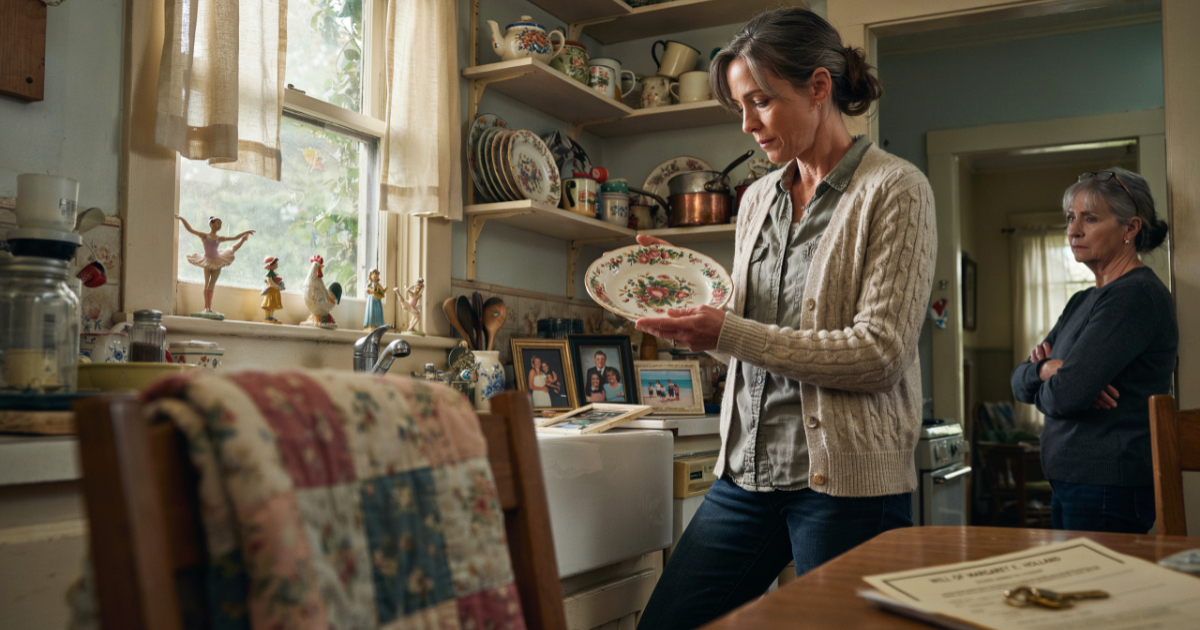
Holloway’s answers came without flinching, until the last one.
“I’m asking about the version where my husband doesn’t come home,” she said.
His expression softened, just barely.
“We’ll have twelve officers within response distance.
But I won’t insult you by pretending there’s no risk in this.”
After he left, Sienna stood at the window with her arms crossed.
“I want to see the Wisconsin property.”
Dante looked up.
“What?”
“There’s a house in the financial records you gave me.
Near the lake.
Bought eight months ago.”
“Yes.”
“Show me.”
They drove out the next morning to a gray stone house at the end of a gravel road lined with bare maples — modest compared to the mansion, with wide windows and a porch facing a frozen lake.
Sienna walked its quiet rooms slowly: a warm, human-sized kitchen, shelves waiting for books, a small studio facing the woods.
Then she stopped at a room at the end of the hall.
The walls had been painted soft cream.
A wooden crib stood beneath the window.
“When did you do this?” she asked, hand resting on the railing.
“Eight months ago.
Before you were pregnant.”
“Why is there a nursery, Dante?”
“Because when I imagined actually getting out,” he said from the doorway, “this is what I imagined coming home to.”
“You never told me you wanted children.”
“I was afraid wanting them would mean wanting a future I had no right to promise you.”
She turned, tears standing in her eyes though her voice stayed level.
“You don’t protect people by keeping the truth from them.”
“I know that now.”
“You keep saying that.”
“Because I’ve learned more in five days than I let myself learn in three years.”
She looked back at the crib.
“I believe you.” He didn’t move toward her.
“I’m still angry.”
“You should be.”
“I don’t know yet if I can stay.”
“I understand that.”
“But I believe you were actually trying to get out.” She met his eyes.
“Come back from that warehouse, Dante.”
“I will.”
“Don’t promise because you think I need to hear it.”
“I’m promising because I plan to spend the rest of my life keeping it.”
*
The warehouse sat near the river under a sky the color of gunmetal.
Dante arrived alone at nine, letting Holloway’s team wire him in a parking structure two blocks off.
“Twelve positions,” Holloway said through the earpiece.
“Nico’s inside with three men.
We need either a direct threat or a clean admission tying him to the shipmenTS.”
“Understood.”
“If it turns, say ‘Christmas.’ We move on the word.”
Inside, industrial lights threw hard white circles across bare concrete.
Nico Conti sat in a metal chair at the center of the empty floor — thirty-five, lean, pale, close enough to his brother’s face that something old and unpleasant stirred in Dante’s memory.
“You came alone,” Nico said.
“You asked me to.”
“I expected the great Dante Marchetti to bring an army.”
“I don’t have one anymore.”
Nico smiled.
“That must hurt.”
“Less than you’d like.”
He circled slowly.
“Do you know why I wanted to look at your face?”
“You’re about to tell me.”
“I wanted to see what betrayal looks like in a good suit.”
“Your brother stole thirty-eight million dollars from me.”
“Your brother built your empire.”
“He threatened my wife to protect himself.
That isn’t loyalty.”
Something tightened across Nico’s face.
In Dante’s ear, Holloway murmured, “Keep him talking.”
Nico stopped directly in front of him.
“How is Sienna?”
Dante’s pulse jumped; his face didn’t.
“Not a subject open to you.”
“Still in the guesthouse, east side of the property?”
The warehouse went suddenly, impossibly quiet.
“You thought I hadn’t done my homework?” Nico said.
“Hold,” Holloway breathed.
“We’re closing in.”
“Sixteen weeks pregnant,” Nico continued.
“Booked for Boston, before you dragged her back off the jet bridge.”
“I dragged her nowhere.”
“No? Maybe she came back because she’s afraid of you.”
“If you wanted to discuss my marriage, you could’ve saved us both the drive out here.”
A man stepped up behind him and pressed a gun barrel to the base of his skull.
Dante didn’t move.
“Thirty seconds,” Holloway whispered.
“Do not escalate.”
Nico leaned in close enough that Dante could see the red threading through his eyes.
“You took my brother from me.”
“Your brother took himself.”
“I can take something from you.”
“You know exactly where my wife is right now, and you came here instead.
That tells me you don’t actually want her.
You want me afraid.”
The gun pressed harder.
“Are you?”
“Yes.”
Nico looked, for one second, genuinely surprised.
Dante kept going before he could recover.
“I’m afraid because she’s the first thing I’ve ever loved more than power.
I spent years convincing myself that fear was weakness, and that lie nearly cost me everything I have left.”
“Then beg.”
“No.”
“Beg me to leave her alone.”
“No.”
“Fifteen seconds,” Holloway counted.
“You think you’re still in control here?” Nico snapped.
“No.
That’s exactly what you’re not understanding.
I’m finished controlling anything.”
“Then why come at all?”
“To give you a choice your brother never gave himself.”
Dante held his eyes.
“Walk away.
Leave the city.
Stop building a life on top of a man whose own betrayal already destroyed him.
Hate me from somewhere far away and stay alive to do it.”
“You expect mercy from me?”
“I’m not offering mercy.
I’m telling you revenge is a cage, and your brother locked you inside it long before federal agents ever laid a hand on him.”
Nico struck him across the mouth.
Blood touched Dante’s lip.
The gun never left his skull.
“Five seconds.”
Nico pulled a second pistol from his coat and pressed it into Dante’s open hand.
“Kill him.” He nodded toward the man behind him.
“Prove there’s still something of the old Dante left in you.”
Dante looked down at the weapon.
Kill, and become exactly the man Sienna was already prepared to leave behind.
Refuse, and maybe never see her face again.
He let the gun fall.
It struck the concrete with a flat metallic crack.
“No.”
“You’ve gone soft.”
“No,” Dante said.
“I’ve finally gotten strong enough to stop.”
The warehouse doors blew inward.
“Federal agents! Down, now!”
The barrel left his skull.
He dropped to one knee as agents flooded the room, and when Nico lunged for the fallen pistol, Dante caught his wrist and pinned him without a single blow thrown.
Ninety seconds later it was over — no shots fired, Nico face-down and cuffed under the harsh white lighTS.
Holloway crouched beside him.
“You good?”
“Yes.”
“The speech with a gun on your head wasn’t in the plan.”
“I improvised.”
“You dropped a loaded weapon on the floor.”
“Trying something new.”
Holloway studied him, then glanced at Nico.
“We’ve got everything — threats, knowledge of your family’s surveillance, the shipment routes, an order to commit murder on tape.
The agreement’s satisfied.”
“Satisfied meaning?”
“You’re out, Dante.”
The words took a moment to land.
For the first time since he was nineteen years old, there was no next meeting waiting, no debt to collect, no rival circling, no organization expecting him to keep becoming its coldest possible version.
He called Sienna from the parking structure.
She picked up on the first ring.
“It’s done,” he said.
“I’m coming home.”
Silence, then a long, shaking exhale.
“I’ll leave the light on.”
*
When he reached the estate, the guesthouse lamp burned steady against the dark.
Sienna waited on the porch in a wool coat over her pajamas.
She saw the bruise on his mouth before he’d even reached the top step.
“What happened?”
“A disagreement.”
“Is Nico alive?”
“Yes.”
“Are you?”
He looked at her.
“Yes.”
She crossed the porch and wrapped both arms around him.
He went rigid for one second, then folded around her — not tight enough to trap, only firm enough to answer.
She pressed her face into his chest, and he felt her breath catch unevenly.
“I was so angry with you,” she whispered.
“You still can be.”
“I am.”
“That’s fair.”
“And I was terrified.”
“I know.”
She pulled back to look at him.
“You don’t get to say that tonight.”
He nodded.
“Then tell me.”
“I was terrified you weren’t coming home.
That the last real thing I’d ever said to you would be telling you not to make a promise you couldn’t keep.”
He touched her face and waited until she leaned into it.
“I came home.”
“Yes.”
“Not because I won anything.”
She looked up at him.
“Because I stopped trying to.”
*
The two weeks did not end in some tidy, dramatic reconciliation.
There was no single morning when every wound simply closed.
Dante moved to the Wisconsin house alone while Sienna stayed on in the guesthouse near the city.
He sat through meetings with prosecutors.
Placed his legitimate companies under independent outside management.
Sold the Winnetka mansion outright, because Sienna said she could never raise a child inside a house that had felt like a cage.
He started seeing a therapist in Evanston every Thursday morning and, for the first few weeks, hated nearly every second of it.
“He keeps asking how I feel,” Dante told her after the third session.
“That’s generally what therapists do.”
“Seems inefficient.”
“Do you actually answer him?”
“Eventually.”
She smiled at that, the first real one he’d earned in weeks.
He learned to cook four separate meals without triggering the smoke detector.
He learned that pregnancy involved far more than doctor’s appointments — sudden exhaustion, nausea over smells that had been harmless the week before, the very real possibility that Sienna might cry because a grocery store had stopped stocking a particular brand of crackers.
He attended every appointment she’d let him attend, and never once assumed he had the right to be there.
He asked first, every single time.
On the fourteenth day, she arrived at the Wisconsin house carrying the manila envelope.
He’d already signed the response agreeing to every term inside it.
The house sat quiet around them except for wind moving through the bare trees.
“I promised I’d sign,” he said.
“I know you did.”
She opened it and studied the signature line by line.
“You gave me the Boston house outright.”
“Yes.”
“Full custody, if that’s what I want.”
“Yes.”
“You waived every right to interfere with my career, or where I live.”
“Yes.
You said the decision would be yours.
I meant it.”
She looked at him for a long moment.
Then she tore the papers once, clean down the center.
His breath stopped in his chest.
“This isn’t forgiveness,” she said, not smiling.
“I understand.”
“It isn’t permission to go back to what we were.”
“I don’t want what we were.”
“I won’t live in silence again.”
“You won’t.”
“I won’t make myself small to fit beside you.”
“I never want you small.”
“If you’re afraid, you tell me.
If there’s danger, we face it with the truth between us, not instead of it.
If you ever shut me out again, I leave — and there won’t be an airport next time.”
He took every word without flinching.
She set the torn halves down on the table between them.
“I’m choosing to try,” she said.
He closed his eyes for exactly one second.
When he opened them, he still didn’t reach for her.
“Why?” he asked.
“Because I saw exactly who you were when you believed power was the only thing keeping you alive.
And then I saw who you chose to become the moment a man put a gun to your head and handed that power straight back to you.”
His voice came out rough.
“I don’t deserve this cleanly.”
“No.
You don’t.” The honesty of it nearly made him laugh out loud.
She stepped closer.
“But love was never a prize handed to flawless people.
It’s a decision made by people who already know exactly what it cosTS.”
She took his hand and pressed it flat against her stomach.
Their daughter shifted beneath his palm, and every trace of Dante Marchetti’s practiced stillness left his face at once.
“I felt her,” he whispered.
“She’s been kicking all morning.”
“Does it hurt?”
“Sometimes.”
“Can I do anything?”
“Stay.”
So he stayed.
*
Three weeks before her due date, they renewed their vows on the shore of the frozen lake.
Eleven guesTS. Sienna’s mother flew in from Boston and spent the first hour watching Dante with the careful suspicion of a woman who remembered every phone call where her daughter had pretended not to be lonely.
Holloway lingered near the tree line in his gray coat, looking like he expected the whole ceremony to require backup.
Dante’s younger sister cried through most of it.
Sienna wore a blue-gray dress and the small gold earrings she’d bought for herself years before she’d ever met him, and walked to the water’s edge alone.
Dante waited there without a tie, without security, without any of the old armor.
“I once believed love meant clearing every danger out of your path before it ever reached you,” he said.
“What I actually cleared out was your voice.
I made choices for you because I was afraid your real choices wouldn’t include me.”
Her eyes filled.
“I can’t promise I’ll never be afraid again,” he went on.
“I can’t promise the past stops existing.
I can promise fear will never turn back into silence.
I’ll tell you the truth before I’ve figured out how to make it sound acceptable.
I’ll listen when your truth is hard to hear.
I will not confuse protecting you with controlling you again.
And I will spend every day I have left becoming the man our daughter deserves to see when she looks at her father.”
Sienna took both his hands.
“For two years I believed your distance meant I wasn’t enough,” she said.
“I understand now I was measuring myself against a silence that had nothing to do with my worth at all.”
His fingers tightened around hers.
“I’m choosing you with my eyes open,” she said.
“Not because none of it matters anymore — because it does, all of it.
We’re not going back to the marriage we had.
We’re building something harder and more honest out of whatever survived it.”
They kept the old rings.
Neither of them pretended the past had been erased — they were building on top of the ruins, not around them.
Their daughter, Vienna Grace Marchetti, was born at 4:17 on a cold Tuesday morning in March, after fourteen hours of labor Dante sat through without leaving her side once, calm through most of it, considerably less calm when Sienna cried out, and completely undone the moment a nurse laid the baby against his chest.
Vienna opened her eyes and studied him with the fierce, solemn concentration only newborns manage.
Dante — a man who had once commanded hundreds — looked helplessly across the room at his wife.
“What do I even say to her?”
Exhausted, pale, smiling anyway, Sienna said, “Start with the truth.”
He looked down at his daughter.
“My name is Dante,” he whispered.
“I’m your father.
I’ve made more mistakes than I can count.
Loving you will never be one of them.”
*
One year to the night after Sienna left that envelope on the counter, snow fell again on Christmas Eve.
The Wisconsin house glowed beside the dark, frozen lake.
Vienna sat propped in her padded chair by the tree, watching the lights with the total seriousness of someone encountering magic for the first time in her life.
Dante knelt on the floor losing a quiet war against a tangled string of ornamenTS. Sienna sat nearby with a book and a cup of tea gone lukewarm.
The house wasn’t silent.
A bottle waited by the sink.
Blankets covered the couch in a heap.
One small sock had gone missing under the table.
Dante’s reading glasses sat beside three heavily dog-eared parenting books.
Every room carried the honest, cluttered evidence of people who actually lived inside it now.
After Vienna finally fell asleep, Sienna and Dante sat together beneath the tree.
“I keep thinking about last Christmas,” she said.
He looked toward the window.
“So do I.”
“You came through that terminal holding a pregnancy test like it might go off.”
“I’d forgotten I was even still carrying it.”
“You looked terrifying.”
“I was terrified.”
“I almost got on that plane.”
“I know.”
“My boarding pass was already in my hand.”
He turned to face her.
“What changed your mind?”
She thought about it for a moment.
“You drove there yourself.
It sounds small now, but by then everything between us went through someone else — assistants, drivers, security, messages passed along secondhand.
Then you walked into that airport completely alone, with no speech ready and no plan at all.”
“I should have given you something real long before that night.”
“Yes,” she said, without softening it.
“You should have.”
Dante no longer needed her to soften anything.
“But you did, eventually,” she went on.
“And then you kept doing it, every single day after.”
Snow gathered along the window ledge.
Upstairs, Vienna made a small sound through the monitor and settled again into quiet.
Sienna rested her head against his shoulder; he stayed still for a moment, honoring the plain weight of her trust, before he finally took her hand.
A year ago, two objects had sat on a marble counter like the end of everything he’d built.
Now the divorce papers were gone.
The pregnancy test lived in a small wooden box upstairs, tucked beside Vienna’s hospital bracelet and the first photograph ever taken of her tiny hand wrapped around Dante’s finger.
The past hadn’t disappeared.
It had simply stopped being the thing steering the future.
Outside, snow settled over the road he had once believed he would walk alone for the rest of his life.
Inside, his wife’s hand stayed folded in his, and for the first time in that life, the man who had built an empire out of fear finally understood that the only real power worth holding was a home where nobody had to be afraid of the truth.
THE END