PART 1
The girl did not cry.
That was the detail that made Nathaniel Reyes take his foot off the gas.
Angry children cried.
Wronged children shouted, kicked at doorframes, ran into the street hoping someone, anyone, would come after them.
This one did none of it.
She simply stood beneath a porch light that buzzed like it was dying, hugging a paper grocery sack to her chest while snow settled into her hair like it had every right to be there.
Through the wide front window behind her, a Christmas table glowed gold with candlelight.
A woman lifted a carving knife over a glazed ham.
Two kids fought over the last dinner roll.
Somewhere at the head of the table, a man threw his head back and laughed at something no one outside could hear.
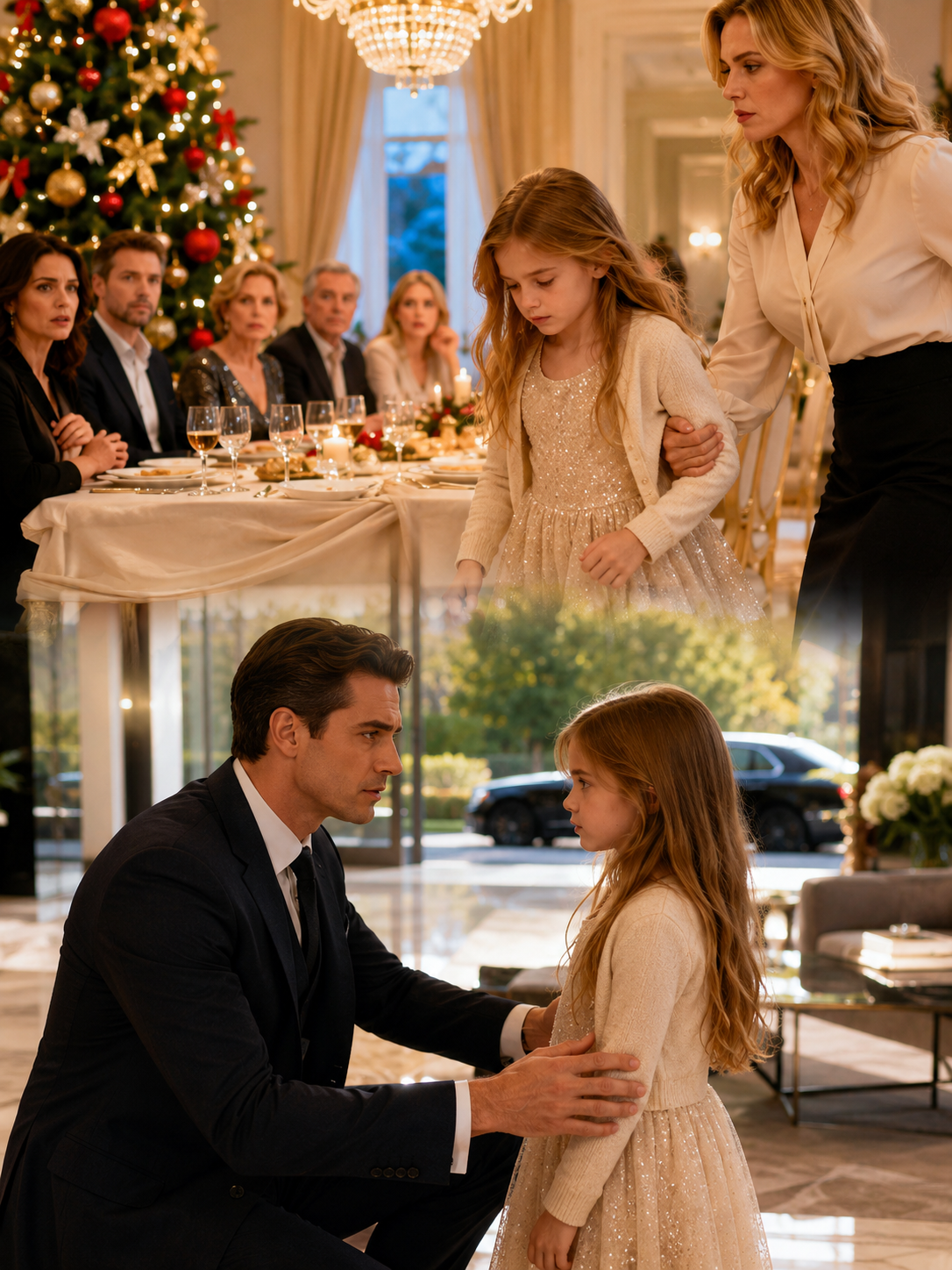
Not one person at that table turned toward the glass.
Nathaniel eased the SUV to the curb.
Twenty minutes earlier he’d walked out of his own company’s holiday gala — out of a ballroom lit up with champagne towers and a jumbotron cycling through photos of families his company had housed that year.
He was supposed to feel something like pride.
Instead, for three straight hours, executives had shaken his hand and called him “the man who understood what Christmas actually meant,” while all he’d been able to think about was the daughter he’d buried nine winters ago.
Grace would have been seventeen this year.
She would have hated that ballroom.
She’d have whispered running commentary through every speech, stolen the chocolate shavings off his dessert plate, and begged to leave early so they could drive around the city rating everyone’s light displays out of ten.
Instead he’d left alone, taken a wrong turn off the highway to dodge an accident, and ended up idling on a quiet residential street in Maple Hollow — irritated by the detour right up until the moment he saw her.
The irritation evaporated instantly.
Her sneakers were soaked through.
No coat.
No hat.
No gloves.
The grocery bag against her chest held, from what he could see, a stuffed rabbit with one ear folded wrong, a library book, and some balled-up clothing.
He’d barely lowered his window when the front door opened again.
A woman stepped out in a red velvet dress and pearl earrings, one hand braced on the frame so the warm air wouldn’t escape past her.
“How much longer are you planning to stand there being dramatic?”
The girl’s eyes dropped to the porch boards.
“I’m sorry.”
“You should be.
You ruined dinner, humiliated me in front of my entire family, and made your brother cry.”
“I didn’t touch Cole.”
“So he’s lying now too?”
“No, ma’am.”
“Then stop performing like you’re the victim here.
Go find somewhere else to sulk until your father’s home.
Maybe the cold will help you think about what you did.”
The girl’s knuckles whitened around the paper bag.
“Can I have my coat, please?”
“You lost that privilege an hour ago.”
The door slammed hard enough to bounce the wreath against the wood.
Nathaniel sat frozen behind the wheel.
He had negotiated deals worth more than most of that neighborhood combined.
He had stared down city councils that wanted his company gone and fired men who thought raising their voice at him would work.
He had trained himself, over two decades, to stay level when everyone else in the room was losing it.
But something hot moved through his chest at the sight of that child standing alone under a dying bulb, and it did not feel like something he could train away.
He killed the engine and got out.
The girl noticed him immediately, and fear crossed her face before he’d even shut the door.
He stayed by the car, both hands visible.
“Hi.
I’m Nathaniel.
I saw you out here and wanted to make sure you’re okay.”
She shook her head fast.
“I’m not supposed to bother anybody.
I’ll be quiet.”
The sentence sounded rehearsed, like a line she’d used before with someone else.
“You’re not bothering me,” he said, keeping the anger out of his voice with real effort.
“Is your dad inside?”
“He works nighTS. At the warehouse.”
“Does he know you’re out here?”
Another shake of her head.
The snow was picking up now, fat flakes catching in her lashes.
Her lips had started losing color.
“What’s your name?”
A pause.
“Wren.”
“All right, Wren.
Is there a neighbor you trust? A grandparent nearby? A teacher?”
“My teacher lives on the other side of town.”
“What about the people inside right now?”
Her eyes flicked toward the door and away again.
“My stepmom said I’m not part of dinner anymore.”
Through the glass, the woman in red had returned to the table, smiling as she spooned gravy over a small boy’s plate.
“What happened?”
“Cole broke Grandma’s glass angel ornament.
He said I pushed him.”
“Did you?”
“No.”
“Did anyone see what really happened?”
“My stepsister did.
But she didn’t want her mom mad at her, so she said she wasn’t sure.”
Wren said all of it flatly, without heat, and that flatness scared him more than tears would have.
“How long are you supposed to stay out here?”
“Until my dad gets home.”
“When’s that?”
“Six in the morning.”
Nathaniel stared at her.
It was barely half past eight.
“Wren, it’s twenty degrees out here.”
“I know.”
He took one step toward the walk, no closer than that.
“I’m going to knock on that door.”
Panic changed her whole posture.
“No, please don’t.”
“She can’t leave you out here in this.”
“She’ll tell Dad I ran away.
He’ll believe her — I’m always the one causing problems.”
“You are not causing this.”
“You don’t know me.”
Quiet.
Precise.
True.
He was a stranger in an expensive coat whose face occasionally showed up in the business section.
None of that gave him the right to be trusted, and he understood that immediately.
He pulled out his phone instead.
“I’m calling for help.
You can hear everything I say.”
Dispatch promised someone would come, eventually — the storm had already caused two house fires and a pile-up on the interstate.
Eventually wasn’t good enough.
He called Diane Foster next, a retired child-welfare advocate who sat on the board of a nonprofit his company funded.
She answered on the second ring.
“Don’t move her without dispatch on record,” Diane said once he’d explained.
“Don’t confront the stepmother past asking for a coat.
Keep the girl calm.
I’m fifteen minutes out.”
Nathaniel walked toward the porch.
Wren retreated to its far edge, still clutching the bag like it was the only thing left that belonged to her.
He knocked.
The door opened on a smile clearly built for expected company.
It died the instant the woman recognized him — half the city knew Nathaniel Reyes’s face from the developments his company had put up around downtown.
“Mr. Reyes?”
PART 2
“Your stepdaughter is outside without a coat.”
The woman blinked, genuinely thrown.
“I’m sorry?”
“It’s below freezing.”
Behind her the table had gone quieter; a few relatives were clearly listening now.
She lowered her voice to something sharp and private.
“Wren is being disciplined.”
“Discipline doesn’t include hypothermia.”
“She put herself out there for attention.
She does this.”
“I heard you tell her to stay outside until her father gets home.”
Color rose along her cheekbones.
“Were you listening to a private family matter?”
“I was watching a child freeze.”
“She isn’t your responsibility.”
“No,” Nathaniel said.
“She’s yours.”
For one unguarded second, the polish slipped off the woman’s face completely.
Then it slid back into place.
“My name is Renata Voss.
My husband works himself half to death, and I hold this house together while raising three kids.
Wren has struggled since her mother died — she lies, she steals, she manipulates.
You’ve walked into something you don’t understand.”
Past her shoulder, a girl of about ten stood near the tree, watching Wren through the glass.
When she caught Nathaniel looking, she dropped her eyes fast.
“Bring her the coat,” he said.
“She refused to wear it.”
“Then bring it out here and let her refuse in front of me.”
“This is harassment.
Get off my property.”
The door shut.
The deadbolt turned.
He crossed back to Wren.
“Is there a coat inside?”
“Dad bought me one.
Blue.”
“Where is it?”
“Hall closet.
Renata keeps it there.”
“Why?”
Wren stared at the paper bag in her arms.
“She says nice things belong to kids who are grateful.”
Headlights swung around the corner — Diane’s old sedan, a patrol car right behind it.
While the officer spoke with Renata at the door, Diane wrapped Wren in an emergency blanket pulled from her trunk.
With the father unreachable and Renata refusing to let the girl back inside without an apology first, the officer documented everything and arranged for Wren to wait it out at a nearby all-night diner.
Nathaniel followed in his own car.
Inside, Wren picked the booth facing the entrance without being asked why.
Diane ordered tomato soup, toast, and hot cocoa, and waited until Wren’s hands stopped shaking before asking a single question.
Nathaniel sat at the end of the booth, unsure he’d earned the right to be there at all.
The waitress set down a plate of cookies nobody had ordered.
“Christmas emergency,” she murmured, and disappeared.
Wren looked at the cookies like she’d never seen food offered without a condition attached.
She was halfway through the soup when the diner door slammed open hard enough to ring the bell twice — and a broad-shouldered man in a warehouse jacket, snow still melting off his boots, spotted her and came straight for the booth, already demanding to know what in God’s name was going on, because his wife had told him his daughter ran off after hurting her brother.
Wren shrank back against the seat.
And that was the moment Nathaniel understood the real fight of the night hadn’t even started yet.
PART 3
Marcus Doyle had spent three years believing he was holding his family together.
His first wife, Anna, had died of a sudden aneurysm when Wren was five, leaving him with a grieving little girl, a mortgage he could barely make, and a warehouse job that paid overtime and asked for everything in return.
Renata had come into their lives during the worst stretch of it — casseroles, laundry folded without being asked, someone who sat beside Wren through the nights she woke up crying for her mother.
Renata had two kids of her own, Piper and Cole, and seemed, back then, to actually understand the particular chaos of blending two broken households into one.
When Marcus married her, everyone told him he’d gotten lucky.
He’d believed them completely.
Whenever Wren went quiet, Renata called it grief-driven manipulation.
Whenever the school called, Renata handled it.
Whenever he sensed something off in the house, Renata reminded him that blended families needed firm boundaries, and he was too tired, too grateful, too far outside the house nine hours a day to argue.
Now it was two in the morning, and he was staring at proof that his daughter had packed her entire life into a grocery sack.
“I bought you a blue coat,” he said.
Wren nodded.
“Where is it?”
“Hall closet.”
“Why weren’t you wearing it?”
“Renata said I didn’t deserve to.”
“That doesn’t — she told me you refused it because you wanted your mom’s old green one instead.”
“That one doesn’t fit anymore.”
“Then why didn’t you just tell me?”
Something shifted in Wren’s face.
Not anger.
Disbelief.
“When?” she asked.
“You leave before I wake up on Saturdays.
You get home after I’m already asleep most nighTS. When I try to talk at dinner, Renata says I’m interrupting.
When I wait up for you, she says you need your rest.”
Marcus opened his mouth.
Nothing came out.
“I asked to come with you to the hardware store last month,” Wren said.
“She told you I wanted to stay home.”
He remembered that Saturday.
He’d bought Piper a desk lamp and Cole a model-truck kit, and brought Wren nothing, because Renata had told him she’d point-blank refused to come.
Diane slid several sheets across the table.
“These are notes from the school counselor, relayed over the phone just now.
Marcus — the school tried to reach you three separate times this fall.”
“I never got anything.”
“Renata answered every message.”
“She told me Wren was already seeing a therapist,” Nathaniel said quietly.
Marcus looked at his daughter.
“Are you seeing a therapist?”
Wren shook her head.
Marcus stared at the crumpled paper bag on the table between them, and something in his certainty cracked wide open.
“I need to talk to my wife.”
“Talk to your daughter first,” Diane said.
“I am talking to her.”
“You’re collecting facts so this can stay a misunderstanding.
It might not be one.
Right now she’s reading your face to decide if the truth is going to cost her your love.
That’s the actual emergency.”
Marcus turned back to Wren.
“What happened tonight? All of it.”
She told him — the ornament that had belonged to her mother, Cole’s lie, Piper’s silence, Renata sending her upstairs and then following with the grocery bag, telling her she could leave if she hated this family so much.
The porch, the cold, the hope that maybe after dinner the door would open again.
“She said everyone gets sad looking at me,” Wren finished.
“Because I have Mom’s face.”
Marcus’s breath caught.
He’d spent years half-avoiding his daughter’s eyes for exactly that reason — Anna’s dark eyes, Anna’s crooked smile, Anna’s habit of twisting a napkin around one finger when nervous — and had told himself working overtime was a form of love, never once considering that to an eight-year-old, absence could feel identical to rejection.
“Are you scared to go home?” he asked.
She looked at Diane, then at Nathaniel, and finally back at her father.
“Will Renata be there?”
He understood the answer in the silence that followed, and stood up.
“Let’s go.”
The Doyle house still had half a dozen cars in the driveway when they pulled up near three in the morning — Renata’s relatives, some staying out of concern, most staying because the drama had gotten more interesting than dessert.
Marcus went in first.
Wren hung back behind Diane.
Renata came at them from the dining room.
“Thank God — Wren, apologize to everyone right now.”
Marcus held up one hand.
“Where’s the coat I bought her?”
“What?”
“The blue one.”
“In the closet.
She refused to wear it.”
He walked to the hall closet and pulled it off the hanger himself.
The tag was still looped through the zipper.
The pockets had never been unstitched.
“She never wore this,” he said.
“I told you—”
“You told me she wore Anna’s old coat instead.
That coat doesn’t fit her anymore, Renata.”
“You’re exhausted and letting strangers manipulate you.”
He carried the coat into the dining room and laid it across the table, candles still guttering over the remains of dinner.
“Why did the school try to reach me three times this fall?”
Something flickered across her face — small, but Marcus caught it this time.
“I don’t know what you’re—”
“Her counselor.
Her teacher.
You told me you’d handled every one of those meetings.”
“I did handle them.”
“You told them she was in private therapy.
She isn’t in therapy at all.”
“I was researching options—”

“For three months? The school offers free sessions, Renata.
Why wasn’t I told any of this?”
“Because you’re never here!” The words tore out of her, louder than she meant, and the whole room went silent around it.
She caught herself, softened her voice into something almost reasonable.
“I have raised your daughter while you worked yourself into the ground.
Her tantrums, her lies, her constant need for attention — I manage all of it so you get to come home and just be the tired, loving dad.”
Wren edged closer to Diane.
Marcus saw it.
Renata saw him see it.
“She’s performing,” Renata said.
“Look at her.
She knows exactly how to make a room feel sorry for her.”
Piper stood frozen near the tree, pale, shaking.
Marcus turned to her.
“Piper.
Did Wren push Cole?”
Renata stepped in front of her daughter.
“Do not interrogate my child.”
“I asked her a question.”
“Mom—” Piper’s eyes were already filling.
“Upstairs.
Now.”
“Mom, I’m sorry—”
“Upstairs, Piper.”
“I saw Cole break the angel,” Piper blurted instead, the words coming faster than she could stop them.
“He was swinging his toy sword around.
Wren tried to grab it away from him and he said she pushed him, because he knew you’d believe him over her.”
Cole started crying.
“I didn’t mean to break it.”
Renata grabbed Piper’s wrist.
“That’s enough out of you.”
“You told me if I ever defended Wren, you’d send me back to Dad’s for good.”
The room made a sound like a held breath finally released.
Renata’s own sister stood up from the table.
“Renata.
Is that true?”
“Stay out of this.”
“You told us Wren was upstairs the whole time.”
“She was supposed to be.”
“You knew she was outside.”
Renata’s face finally, completely, came apart.
“I needed one peaceful dinner! One night without Anna’s ghost sitting at my table, without everyone comparing me to a dead woman.
He keeps her pictures up in the hallway.
That girl looks at me like I stole her mother’s whole life.
Do you have any idea what that feels like?”
“I never said that,” Wren whispered.
“You didn’t have to!”
Marcus stepped between them.
“Stop.”
Renata stared at him — she had never once heard that tone from him before.
“You made my daughter stand outside in freezing weather,” he said.
“She was on the porch, not the street—”
“You packed her things into a grocery bag.”
“To scare her into apologizing.”
“You’ve been keeping food from her.”
“That’s a lie.”
“I keep crackers in my backpack,” Wren said quietly, from behind Diane.
“For the nights Renata says sad kids shouldn’t eat with happy families.”
An aunt at the table pressed a hand to her mouth.
Renata shook her head, fast and small.
“She twists everything.”
Marcus walked into the kitchen and started opening cabineTS. Nothing, at first.
Then Piper pointed silently toward a plastic bin shoved onto the shelf above the refrigerator.
Inside: unopened school notices, letters addressed to him he’d never seen, Wren’s report cards, two birthday cards from Anna’s parents in Arizona, and small unopened packages that had never once reached his daughter’s hands.
He opened one envelope, postmarked six months earlier — a birthday card, a photograph, a check for fifty dollars.
In the envelope beneath it, the check had been removed entirely.
“They told me they’d stopped writing,” Wren said softly.
Marcus looked up.
“Where’s the money?”
Renata looked away.
“You should stop answering anything until you have a lawyer,” Nathaniel said.
Every head in the room turned toward him.
It wasn’t protection.
It was a warning, plain and clear.
“You think because you’re rich you get to walk into my house and judge me?” Renata snapped.
“No,” Nathaniel said.
“I think a child stood outside your house tonight, and now everyone inside it finally has to look at you.”
Renata turned back to Marcus.
“Tell them to leave.”
“You’re the one leaving.”
“This is my house.”
“It’s Wren’s house too.”
“You’d throw me and my own children out on Christmas over that girl’s lies?”
“Piper and Cole can stay tonight if they want.
They’re kids.
I’m not punishing them for what you did.” Marcus crossed the room, picked the grocery bag up off the floor, and set it down beside his own chair at the table.
Then he pulled the chair out for his daughter.
“I have been choosing wrong for three years,” he said.
“Tonight I’m choosing her.”
“You’ll regret this.”
“I already regret enough.”
Diane arranged for Renata to spend the night at her sister’s.
Piper and Cole chose to go with their mother, though Piper hugged Wren tight on the way out and whispered an apology Wren didn’t answer right away.
When the house was finally quiet, Marcus locked the door and switched off the porch light.
Wren stood in the hallway.
“Do I have to sleep upstairs by myself?”
He thought of every closed bedroom door he’d walked past believing it meant privacy instead of exile.
“No.
You can sleep wherever feels safe.”
“Can I take the couch?”
“I’ll take the chair next to it.”
“You have work in the morning.”
“I’m not going.”
“Will you get fired?”
“No.” It wasn’t entirely true — missing the shift would cost him, losing the overtime would cost more — but Nathaniel spoke up before he had to finish the lie.
“My company runs an independent family assistance fund,” he said.
“Legal consultations, temporary wage support, no strings.
You’d apply like anyone else in the city.”
“I don’t want charity.”
“Then don’t take it as charity.
Take it as the kind of support every working parent should’ve had long before a stranger happened to take a wrong turn down your street.”
Something like respect crossed Marcus’s face for the first time that night.
Outside on the porch, Diane pulled Nathaniel aside.
“You did well tonight.”
“That doesn’t sound like a compliment.”
“It’s a warning.
Wren is not Grace.”
He watched through the window as Marcus spread blankets over the couch while Wren propped her stuffed rabbit against a pillow.
“I know that.”
“Do you? Grief can make rescuing a child feel like getting someone back.
She can’t carry that weight for you.”
“I don’t want her to carry anything.”
“Good.
Then build the bridge and let her decide, in her own time, whether she wants to cross it.”
*
The truth didn’t fix the Doyle family overnight.
It only ended the lie holding it together.
By January, Marcus had filed for separation, and a child-welfare investigation documented what had really been happening — emotional neglect, food restriction, unsafe punishment, intercepted mail, misused funds sent for Wren’s care.
Renata denied most of it and called the Christmas incident an isolated mistake blown up by a wealthy outsider with something to prove.
But the case never rested on Nathaniel.
It rested on paper.
The school had emails.
Police had photographs of soaked sneakers and a paper-thin sweater.
A neighbor confirmed seeing Wren alone in the garage more than once.
Piper told a specialist that her mother routinely blamed Wren for every fight in the house and warned the other children never to defend her.
The bin above the refrigerator held two years of hidden letters that made silence, finally, impossible.
Marcus cut back his hours.
The smaller paycheck scared him less than the realization that his daughter had spent years measuring his love by how rarely he was home to give it.
He went to parenting classes every Thursday.
Wren saw a counselor every Tuesday and, for a long time, said almost nothing in the room — she drew instead.
Houses with locked doors.
Houses with no windows at all.
In nearly every drawing, a small green figure stood outside, alone, in the cold.
Marcus never asked when the drawings would turn happy.
He learned, slowly, that healing moved slower when someone kept demanding proof it was working.
He learned to stop filling every silence with another apology.
The first “I’m sorry” had mattered.
After that, breakfast mattered.
Showing up at school mattered.
Answering his phone mattered.
Remembering library day mattered.
Keeping the fridge full mattered.
Listening without needing to defend himself mattered most of all.
Wren stayed careful for a long time.
She asked permission before opening the refrigerator.
She kept a stash of crackers under her mattress.
Once, when Marcus raised his voice on a call with the insurance company, she locked herself in the bathroom for nearly an hour, and he sat outside the door the whole time.
“I’m not angry with you,” he said through the wood.
Nothing.
“You don’t have to come out till you’re ready.” Still nothing.
“I’ll be in the kitchen making grilled cheese.”
Ten minutes later, the door opened.
She didn’t apologize.
He didn’t ask her to.
Nathaniel kept his distance on purpose.
He paid nothing directly to Marcus and never once appeared at a hearing — his company’s independent assistance fund approved the wage support the same way it did for dozens of other families that winter, no different treatment, no strings.
He quietly redirected the budget for an extravagant corporate anniversary party into emergency legal aid, winter shelter beds, and family counseling instead.
When his PR director pitched a campaign around it, he refused flatly.
“No interviews.
No photographs.
No story about me saving anybody.”
“This could completely reshape your public image.”
“That’s exactly why we’re not doing it.”
For nine years he’d given money from a careful distance, because distance felt safe — buildings didn’t remind him of Grace’s laugh, and scholarship funds never asked why he stopped celebrating Christmas.
A frightened child on a porch had forced him to finally understand the difference between generosity and presence.
Money could build a door.
It couldn’t convince a child the door would stay open.
He saw Wren occasionally after that, always with Marcus’s blessing, usually somewhere public.
The first time, they met Diane at the diner, and Nathaniel brought a box of colored pencils — nothing extravagant, nothing that demanded gratitude in return.
Wren studied the box.
“There’s forty-eight colors in here.”
“Apparently twelve wasn’t enough for someone.”
She almost smiled at that.
“Did your daughter like drawing?”
“She liked drawing on things she wasn’t supposed to.
Walls.
Furniture.
My car, once.”
“What did you do?”
“Told her I was furious.
Then made her help me clean it off — except I left one small part she missed, on purpose.”
“Why?”
“Because after she was gone, that was the only car in the world with something she’d drawn on it.”
Wren considered that carefully.
“What was it?”
“A purple dinosaur wearing a crown.”
She laughed — a real one, short and surprised — and something in Nathaniel’s chest loosened for the first time in almost a decade.
By spring, Wren was video-calling her maternal grandparents every week.
Marcus apologized for ever believing Renata’s claim that they’d simply stopped writing.
Forgiveness didn’t arrive on schedule for either of them, and Marcus learned that accountability wasn’t a door you walked through once — it was a road you had to stay on long after anyone was watching.
Piper and Cole stayed with Renata, though Piper started spending some weekends at Marcus’s place once counselors agreed it would help both girls.
The first visit, she stood in the hallway holding an overnight bag and a stack of cards.
“I brought your birthday cards.
The ones Mom kept.”
Wren took them.
“Did you know? About all of it?”
“Not at first.
Later, yes.”
“Why didn’t you say anything?”
Piper’s eyes filled.
“I was scared she’d stop loving me too.”
Wren looked at her for a long moment.
Then she stepped aside from the door.
“You can come in.”
They didn’t become instant sisters again — they fought over the TV remote and bathroom time, and Piper sometimes went quiet whenever Renata’s name came up, and Wren sometimes accused her of hiding behind that silence.
But the anger existed now inside a house where both of them were allowed to stay.
That, it turned out, was most of what progress actually looked like.
In July, the county attorney called about the financial case — Renata had agreed to repay the money taken from Wren’s birthday checks and to court-ordered counseling of her own.
Contact between her and Wren would stay suspended unless Wren’s therapist recommended otherwise.
Marcus sat at the kitchen table after the call.
Wren was eating cereal, even though it was nearly noon.
“Is she going to jail?” she asked.
“No.”
“Is she sorry?”
“I don’t know.”
“Then what’s the point?”
“It means the adults made rules to keep you safer.”
“Rules didn’t help before.”
“You’re right.
They didn’t.” He didn’t argue the point, and she looked up, surprised by that.
“Rules only work when someone’s actually paying attention.
I’m paying attention now.”
“Forever?”
He wanted to promise it.
He chose the truer thing instead.
“Every single day.
And if I ever miss something, I need you to tell me — and if you can’t tell me, tell your counselor, your teacher, Diane, or Grandma.
You never have to protect me from the truth again.”
Wren pushed her bowl away.
“Renata used to say telling the truth would destroy the family.”
Marcus looked around the small kitchen — the fridge covered in school flyers and Wren’s drawings and a calendar marked up with counseling appointments in her own careful handwriting.
“Sometimes telling the truth destroys the thing that was only pretending to be a family,” he said.
“And that’s what finally gives you a shot at building a real one.”
*
The next snow fell almost exactly eleven months after the night on the porch.
Marcus had saved enough to finally fix the old furnace.
He’d traded most of his overtime for a daytime shift after finishing some extra training, and while the paycheck was only a little better, he was home before dinner most nights now, which mattered more than any raise could have.
On Christmas Eve, the house smelled like roast chicken, cinnamon, and bread Marcus had nearly burned twice.
Wren sat at the table in a red sweater she’d picked out herself.
Her blue winter coat hung by the front door, scuffed at the elbows now, missing one button.
Marcus loved every sign of wear on it.
Piper and Cole came for the evening.
Diane was there, along with the elderly neighbor from next door, Mrs. Alvarez, who’d once seen Wren alone in the garage and never forgotten it.
Nathaniel stood on the porch holding a pie he’d nearly talked himself out of buying, because holidays still dragged Grace’s absence into every room he entered.
But Wren had mailed him a card two weeks earlier with three words on the front.
Please come inside.
So he did.
Marcus opened the door.
“You’re late.”
“I run a company.
People usually let that slide.”
“I work in a warehouse.
We notice everything.”
Nathaniel handed over the pie.
“Store-bought.
I’ll admit it up front.”
“Improves our odds of survival, then.”
Wren appeared behind her father and glanced past Nathaniel at the falling snow.
“You can close the door now,” she said, and he stepped inside, leaving the porch light glowing over the empty steps behind him.
Halfway through dinner, Cole knocked over a glass of milk.
It didn’t break, but he froze solid anyway, and for one long second the old fear crept back into the room and sat down at the table with everyone.
Marcus reached calmly for a towel.
“It’s milk.
Nobody’s getting sent anywhere.”
Cole cried regardless.
Piper wrapped an arm around him.
Wren climbed down from her chair without being asked and helped wipe the floor herself.
Nathaniel watched from across the table and understood, finally, that healing was never the absence of fear.
It was what happened after fear showed up uninvited and discovered the ending had quietly changed.
Later, Wren passed out a stack of drawings — one for Diane, one for Mrs. Alvarez, one for Piper.
The last one she handed to Nathaniel.
It showed a house under falling snow.
A crowded, imperfect Christmas table — one figure’s arms drawn too long, another seeming to float above its chair, a turkey that looked more like a brown cloud than a bird.
Outside, the porch stood empty.
Inside, near the window, stood a tall man in a dark coat, and beside him a smaller figure in red.
At the bottom, in careful eight-year-old handwriting: Thank you for stopping your car.
Nathaniel stared at the words for a long moment.
Nine years of donated buildings and named scholarships and grateful headlines, and no one had ever once thanked him simply for stopping.
“I almost kept driving,” he admitted.
Wren leaned against the table.
“But you didn’t.”
“No.”
“Why not?”
He thought of Grace — of every December turned into a hallway he rushed through with his eyes on the floor.
Then he thought of a small girl standing under a dying porch light, not crying, because she’d already stopped expecting anyone to come.
“Because I saw you,” he said.
She thought about that, then shook her head.
“You saw me before you knew me.
That’s different.”
“How is it different?”
She looked around the table — at Marcus serving pie, at Piper straightening Cole’s napkin, at Diane laughing with Mrs. Alvarez, at the empty porch beyond the glass.
“You didn’t decide I was bad first.”
Nathaniel felt his eyes sting and didn’t bother hiding it.
Across the table, Marcus caught his gaze — no triumph passed between them, only a quiet kind of recognition.
Marcus hadn’t become a perfect father.
Nathaniel hadn’t become a replacement for the daughter he’d lost.
Wren hadn’t forgotten the cold, and one warm Christmas hadn’t erased years of being sent away from the table.
But the family in that house no longer measured love by perfection.
They measured it by presence.
By truth.
By whether a chair stayed pulled out and waiting when someone was frightened, or angry, or grieving, or simply difficult to love that day.
After dessert, Wren carried her plate to the sink without being asked.
“You don’t have to clean up tonight,” Marcus said.
“I know.”
“Then why are you doing it?”
“Because I live here.”
The answer was so plain it stopped the whole room for a second.
Marcus pulled her into his arms.
She stood stiff for a moment before hugging him back, tight, like she finally believed the embrace wasn’t going anywhere.
Outside, snow gathered on the same porch where, one year earlier, she had waited in the cold with a paper bag holding everything she believed she was allowed to keep.
The porch light stayed on.
Not as a warning this time.
Not as punishment.
Not as proof that warmth belonged to somebody else.
Just a light beside a door that opened from the inside.
And this Christmas, the little girl was already standing where the warmth was.
THE END