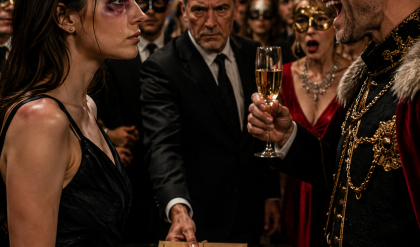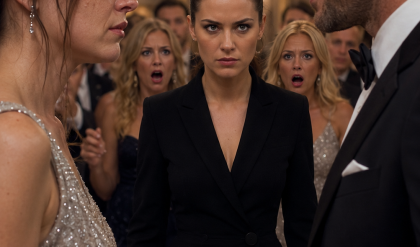
One guard cleared his throat.
“Her invitation has been verified, sir.”
Richard stared at him.
“I don’t care.”
“We have no legitimate reason to remove her.”
“She insulted me in front of my guesTS.”
The guard’s expression remained neutral.
“That is not a security violation.”
For the first time that evening, Richard seemed uncertain.
It lasted only a second.
Then his smile returned.
“Stay, then,” he told Annie.
“Cling to your little chair.
This will probably be the last event like this you ever attend.”
Annie sat down beside Ruth.
“Yes,” she said.
“And I’m staying.”
That simple act unsettled Richard more than shouting would have.
He had publicly ordered her to leave.
Yet she calmly adjusted Ruth’s shawl over her wet dress and faced the stage as though he no longer possessed the authority to decide whether she belonged there.
Richard walked away.
Vanessa followed him.
Near the stage, she whispered, “We should remove her quietly.”
“Then find a reason.”
“Her invitation is valid.”
“Find another reason.”
At Annie’s table, Ruth placed a folded napkin beneath the dripping hem of the dress.
“You could go dry off,” she said.
“If I leave now, he’ll tell everyone I was escorted out.”
“I’ll go with you.”
Annie shook her head.
“My mother used to say there are moments when leaving protects your dignity and moments when staying does.”
Ruth studied her face.
“Which one is this?”
“The second.”
The auctioneer returned to the microphone.
He was an older man named Charles Bennett, and his hands trembled slightly as he raised the wooden gavel.
“Ladies and gentlemen, we will continue with our next item.
A private dinner for twelve at the Atlanta Heritage Museum, followed by a curator-led tour of its civil rights archive.
Opening bid, twenty thousand dollars.”
Silence.
Richard looked pointedly at a state senator seated near the front.
The senator reluctantly raised his paddle.
“Twenty thousand.”
The auction struggled to forty-two thousand dollars, less than half the amount a similar package had raised the year before.
Richard blamed Annie.
The guests, however, were watching him.
A young server approached Annie’s table carrying two glasses of water.
His name tag read Daniel Harris.
His hands shook as he placed one glass before Ruth and another before Annie.
Vanessa appeared immediately.
“What are you doing?”
“Serving the guesTS.”
“You were told not to serve this table.”
Daniel looked at Annie’s soaked dress.
“She has a valid invitation.”
“I gave you an instruction.”
“I can’t refuse someone water because Mr. Holston is angry with her.”
Vanessa lowered her voice.
“Take the glass away and report to the kitchen.”
Daniel tightened his grip on the tray.
“My mother worked banquet service for thirty years.
She taught me that the person everyone overlooks is often the person who should be served first.”
Ruth gave him a small smile.
Vanessa’s cheeks flushed.
“You are finished here.”
Daniel placed the tray on the table.
“Yes, ma’am.”
He walked away without removing Annie’s glass.
Vanessa reached for it herself.
Annie placed her hand around the glass.
“Is there a rule preventing me from drinking this?”
The two women stared at each other.
Vanessa slowly withdrew her hand.
“You enjoy creating scenes.”
“No,” Annie replied.
“I’ve simply stopped helping you hide them.”
Before Vanessa could answer, Richard stepped onto the stage and took the microphone.
“Ladies and gentlemen, I apologize for tonight’s disruption.”
Annie lifted the glass and took a sip.
Richard watched her.
“Unfortunately, some individuals confuse access with entitlement.
This event was created to serve communities in need, not to provide a platform for personal grievances.”
Scattered applause rose from his closest supporters.
Most of the room remained silent.
Richard continued.
“The Holston Foundation has spent more than twenty years bringing housing, education, and clean water to families who might otherwise go without them.
We will not allow one person’s desire for attention to distract us from that mission.”
“He’s making this your fault,” Ruth whispered.
“I know.”
“True charity requires discipline,” Richard said from the stage.
“It requires standards.
Sometimes it requires removing those who exploit generosity.”
Annie stood.
Before she could answer, the ballroom doors opened.
Malcolm Reed entered carrying a leather document case.
Two attorneys followed him, along with a technology executive and Margaret Sloan, the senior vice president of the bank financing Richard’s redevelopment project.
Malcolm had handled acquisitions, lawsuits, and family crises for more than twenty-five years without letting emotion alter his expression.
Tonight, his face changed the instant he saw Annie.
His eyes moved from her wet hair to Ruth’s shawl and then to the darkened blue fabric beneath it.
“Miss Whitmore?”
The name traveled through the ballroom.
Whitmore.
Guests began whispering.
Vanessa stared at her tablet.
Richard stopped speaking.
Malcolm crossed the ballroom, removed his jacket, and placed it over Annie’s shoulders.
“What happened?”
Richard descended from the stage.
“There has been a misunderstanding.”
Malcolm did not look at him.
“I asked Miss Whitmore.”
Annie held Richard’s gaze.
“Mr. Holston poured water on me.”
Richard raised both hands.
“That is an unfair description of an accident.”
“Your hand was steady,” Annie said.
“So was your explanation.”
One of Malcolm’s attorneys opened a notebook.
Richard noticed.
“There is no reason to turn an unfortunate social mistake into a legal matter.”
Malcolm looked at Annie.
“Were you injured?”
“No.”
“Did anyone touch you?”
“No.
But security followed me.
Staff members were ordered not to serve me.
Miss Cole tried to remove the first glass of water someone finally brought.”
The attorney continued writing.
Vanessa stepped forward.
“We had concerns about the validity of her invitation.”
“Did you verify it?” Malcolm asked.
“The system showed a valid entry.”
“Then what remained in doubt?”
Vanessa said nothing.
Ruth answered for her.
“The girl holding it.”
Malcolm gave Ruth a small nod.
Richard approached Annie with the warm, patient expression he normally reserved for television cameras.
“Miss Whitmore, if I had known you were connected to Mr. Reed’s organization, the evening would have unfolded differently.”
Annie looked at him.
“That is not the defense you think it is.”
Richard’s smile faltered.
Malcolm placed the leather case on Annie’s table.
“Miss Whitmore is not merely connected to our organization.”
Vanessa’s tablet chimed.
A profile appeared on the screen.
Annie Evelyn Whitmore.
Chair and controlling trustee of the Whitmore Water Legacy Trust.
Guest of honor.
Final approval authority.
Vanessa’s face lost its color.
Richard looked from the tablet to Malcolm’s case.
Then Margaret Sloan asked quietly, “Should we move the grant meeting upstairs?”
Richard heard her.
“Grant meeting?”
No one answered.
“How much are we discussing?” a guest whispered.
Malcolm finally looked at Richard.
“Fifty million dollars.”
The ballroom went silent.
Richard stared at the young woman whose dress he had soaked.
The girl he had called a trespasser controlled the single largest grant his organization had ever pursued.
And inside Malcolm’s leather case were the final documents Richard had expected her to sign that night.
Part 2
Richard recovered quickly.
Men like him often did.
Fear did not soften him.
It made him more careful.
“Miss Whitmore,” he said, lowering his voice, “surely we can discuss this privately.”
Annie sat beside Ruth.
“No.”
Richard blinked.
“You were comfortable humiliating me publicly when you believed I had no influence,” Annie said.
“There is no reason for privacy now.”
Several guests lifted their phones higher.
Richard glanced toward them.
“I apologize if my remarks were interpreted in a way I did not intend.”
“You said I came for leftover food.”
“I was given incorrect information.”
“You saw my identification.”
“There were security concerns.”
“You created them.”
Vanessa stepped forward.
“Mr. Holston relied on my assessment.”
Richard turned sharply.
“Vanessa.”
She stopped speaking.
Annie watched the exchange.
It had taken Richard less than a minute to begin moving responsibility toward the woman who had enforced his instructions.
Malcolm noticed as well.
“The final grant documents are here,” he said.
Richard’s shoulders relaxed slightly.
“Good.
Then perhaps we should return to the purpose of the evening.”
“The purpose of our visit,” Malcolm said, “was to review the final conditions before Miss Whitmore made her decision.”
Richard frowned.
“I was under the impression approval was a formality.”
“Nothing involving fifty million dollars is a formality.”
Ruth turned to Annie.
“You were deciding where that money would go?”
“Yes.”
“And they knew a representative was coming?”
“They knew the trust would send someone.”
Ruth looked toward Richard.
“They just didn’t imagine that person would look like you.”
Annie folded her hands over Malcolm’s jacket.
“That was the first thing I learned tonight.”
Richard stepped closer.
“Schools are waiting.
Families are depending on this project.
Whatever happened between us should not interfere with that work.”
Minutes earlier, he had called her an intruder.
Now he spoke as if they were colleagues carrying a shared burden.
“The children were waiting before tonight,” Annie said.
“They will still matter after your guests go home.”
“Exactly.
Which is why we shouldn’t make a decision based on emotion.”
“You poured water on me and called it a lesson.
Do not mistake my restraint for uncertainty.”
Richard glanced toward the phones.
“The documents should be signed tonight.”
“They can wait.”
His expression tightened.
“After everything that happened, you intend to stay?”
Annie lifted the glass Daniel had brought and took another sip.
“I said I would.”
Malcolm pulled out the empty chair beside her.
“Then I will stay, too.”
The attorneys sat at the table behind them.
Margaret Sloan closed the folder in her hands and took a seat nearby.
For the first time that evening, Richard was no longer the most powerful person in the room.
Yet Annie noticed something more important.
Ruth had covered her wet shoulders before Malcolm arrived.
Daniel had served her water before anyone knew her last name.
Everyone else would have to prove that their sudden concern was about something other than fifty million dollars.
The auction resumed, but the energy had changed.
Richard returned to his table and ordered Vanessa to remove any language suggesting that the Whitmore grant had already been approved.
“The main presentation is already loaded,” she whispered.
“Change it.”
“The technical team needs time.”
“Buy it.”
A polished promotional video appeared on the screen before she could stop it.
Children opened classroom fauceTS. Families walked through model apartmenTS. Doctors greeted patients in a bright clinic.
Then the words appeared.
The Holston Legacy District powered by Whitmore Filtration Technology.
Annie sat forward.
Malcolm turned to the trust’s technology executive.
“Did we approve that?”
“No.”
“Did we license the name?”
“No.”
“Stop the video,” Malcolm said.
The screen went black.
Richard rose.
“What is the problem now?”
“Your organization is using Whitmore technology and promotional material without authorization.”
“The partnership has been under discussion for monThS.”
“Discussion is not permission.”
Richard spread his hands.
“The public needs to understand what the project could accomplish.”
“Then the word proposed should appear on every image,” Annie said.
“Did you show this material to lenders?”
Margaret Sloan looked at Richard.
He answered too quickly.
“Only in preliminary conversations.”
“With which institutions?” Margaret asked.
“This is hardly the appropriate setting.”
“You displayed our bank’s logo in a ballroom full of donors and public officials.
That made it the setting.”
The auctioneer lowered his cards.
Guests who had expected dinner and bidding now watched the stage as though it were a congressional hearing.
Annie asked the hotel’s technical staff to preserve every version of the presentation.
Richard stepped into the path of one of Malcolm’s attorneys.
“You have no authority to seize event property.”
“We are requesting preservation of material containing our client’s protected technology.”
“I said we will discuss it later.”
Annie rose.
“My mother once gave money to people who promised they would move quickly.
They used urgency to avoid questions, and children paid for it.
I will not repeat her mistake because this room finds scrutiny inconvenient.”
Richard seized the microphone.
“There is no scandal here.
We are discussing ordinary details of a major partnership.”
Annie looked toward the blank screen.
“Then ordinary details should survive ordinary questions.”
Several guests nodded.
Vanessa’s tablet vibrated.
She read the message and leaned toward Richard.
“The technical team found three versions of the presentation.
One for tonight and two labeled for lenders.”
Richard’s grip tightened around the microphone.
Vanessa lowered her voice.
“Both lender versions describe the Whitmore grant as committed.”
Annie could not hear the words, but she saw the change in Richard’s face.
It was not guilt.
It was fear of losing something he had already begun treating as his own.
Margaret approached the stage.
“Did you tell lenders the grant was guaranteed?”
“I told them the partnership was progressing.”
“That was not my question.”
“The trust spent six months negotiating with us.
We had every reason to expect approval.”
Malcolm opened his leather case and removed the unsigned term sheet.
“Approval depends on technical review, community oversight, land-use disclosure, and Miss Whitmore’s signature.”
“Those are standard conditions,” Richard said.
“Conditions are not decorations,” Annie replied.
Ruth leaned over the project map on Malcolm’s tablet.
“What exactly were you asking the bank to finance?”
“Housing, medical facilities, classrooms, retail space, and water infrastructure.”
“Affordable housing?”
“Yes.”
“For how long?”
Richard hesitated.
Vanessa answered.
“The affordability schedule is still under review.”
Ruth nodded toward the completed renderings on the screen.
“So the pictures are finished, but the promise is not.”
A murmur spread through the room.
Annie turned to Margaret.
“Does the lender package identify how many current residents will be relocated?”
“It refers to site-transition expenses but does not provide a household count.”
“The census is incomplete,” Richard said.
“People are not a census problem,” Ruth replied.
“They are families.”
“Developments of this scale require difficult decisions.
Some structures must be removed so better ones can be built.”
“Do the people living there get to return?” Annie asked.
“The plan includes residential uniTS.”
“That was not my question.”
Richard’s silence answered more than a speech could have.
Ruth pointed to a parcel on the map.
“That was Franklin Middle School.”
“It closed six years ago,” Richard said.
“The building closed.
The children didn’t disappear.”
Her finger moved to another property.
“That was Mount Olive Baptist Church.
They delivered bottled water from the basement when the school fountains became unsafe.”
“The church sold voluntarily.”
“After three years of contamination and collapsing property values.”
A cluster of properties was marked Peach Tree Holdings Group.
Ruth’s face changed.
“I remember that name.”
Malcolm spoke quietly to an attorney.
The man stepped away to make a call.
“When were those properties purchased?” Annie asked.
Margaret checked the lender documenTS.
“Between eight and eleven years ago.”
“That was during the worst of the water complaints,” Ruth said.
Richard folded his arms.
“You are drawing conclusions from incomplete information.”
“Then complete it.”
His voice dropped.
“You are nineteen years old.
You do not understand how cities are rebuilt.”
“My mother understood enough to know families should not lose their homes because powerful people can wait longer than they can.”
Something flickered across Richard’s face at the mention of Evelyn Whitmore.
Recognition.
Annie saw it.
“You knew what my mother was investigating.”
Richard laughed.
“That is absurd.”
“You reacted before anyone explained it.”
Vanessa looked at him.
“What investigation?”
He did not answer.
The attorney returned and handed Malcolm his phone.
Malcolm read the message.
“Peach Tree Holdings was controlled through three limited-liability companies.
The final ownership interest traces back to Holston Urban Development.”
The silence that followed was different.
This was no longer discomfort over a cruel scene.
It was the silence of people realizing that the cruelty might be connected to something larger.
Ruth looked at Richard.
“You bought those homes while children were still drinking bottled water.”
“I purchased distressed property through lawful channels.”
Annie remembered something her mother had once told her.
The worst betrayals rarely arrived with threaTS. They arrived with paperwork, delays, and powerful people insisting everything had been done legally.
“What happened tonight wasn’t an accident,” Annie said.
“And I don’t think the failure of that water project was an accident either.”
Richard’s anger gave way to fear.
He straightened his cuffs.
“A charity auction is being turned into a trial based on assumptions and personal resentment.”
“No one has accused you of a crime,” Margaret said.
“I asked why your financing materials described an unsigned grant as committed.”
“Large developments rely on projections.
That is how business works.”
“Expected is not the same as approved,” Malcolm said.
Richard pointed toward the parcel map.
“Those buildings were neglected.
Businesses were leaving.
We took a risk when everyone else abandoned the area.”
“The residents had not abandoned it,” Ruth said.
“Sentiment does not repair infrastructure.”
“Neither does forcing people out and calling the empty land an opportunity.”
A retired banker named Walter Pierce stood.
“I financed redevelopment projects for thirty-seven years.
Distressed property usually becomes profitable because someone knows public investment is coming.”
Richard stared at him.
Walter continued.
“The question is whether Peach Tree knew the water project would fail before it began purchasing property.”
“Be careful what you are suggesting.”
“I’m asking for dates.”
The ballroom began to change.
A former city contractor remembered delayed permiTS.
A pediatrician recalled increased lead screenings.
A property owner said Peach Tree had offered to buy her house months before officials publicly acknowledged contamination.
Richard tried to interrupt, but the room no longer waited for his permission.
Annie knew many of these people had found their voices only after learning who she was.
Still, late evidence was evidence.
She asked an attorney to record the names of anyone willing to provide documenTS.
“You are collecting accusations in the middle of my event,” Richard said.
“I’m collecting information.”
“You’ve already decided what you believe.”
“No.
I decided what requires investigation.”
“That distinction won’t matter when the press publishes this.”
Annie looked at the phones pointed toward him.
“You should have considered that before pouring water on a nineteen-year-old girl.”
Richard looked away first.
Malcolm turned to Vanessa.
“Who approved the lender presentations?”
“The communications department assembled them.”
“Who approved the final language?”
Richard answered for her.
“This is not the place for an internal review.”
Malcolm kept his eyes on Vanessa.
“Did Mr. Holston approve it?”
Richard’s voice rose.
“Vanessa.”
She flinched.
Then she looked down at her tablet.
“His office approved the lender versions.”
“My office receives hundreds of documenTS.”
“You added the projected closing date,” Vanessa said.
The ballroom fell silent again.
Richard moved toward her.
“You are confused.”
“No.
You told us the grant would be signed tonight.
You said the trust had nowhere else to go because Hopewell was the only organization large enough to manage the rollout.”
His stare held her in place.
Vanessa’s voice became quieter.
“You also told lenders the technology agreement was complete.”
Richard stepped closer.
“You should choose your next words very carefully.”
Vanessa swallowed.
“I have the emails.”
Richard turned to security.
“Remove her access to all event systems.”
 After Ex Lies About Children’s Academics, She Wonders If She Should Seek Court-Enforced Communication Limits
Neither guard moved.
“Does no one remember who employs them?” Richard demanded.
“The hotel employs us,” one guard replied.
A few guests lowered their heads to hide smiles.
Ruth leaned toward Annie.
“Power looks permanent until the first person stops obeying it.”
“My mother said the loudest man in a room is often standing on the quiet work of people he never thanked.”
Richard returned to the microphone.
“Children need clean water.
Families need housing.
We cannot allow confusion to destroy years of work.”
His appeal worked better than his anger.
He was using the community as a shield.
Annie stood.
“He is right about one thing.
The children should not lose help because the adults responsible for it failed.”
She turned to Malcolm.
“How quickly can the trust establish emergency funding outside this project?”
“For water delivery and testing, forty-eight hours.
Temporary filtration could begin within two weeks.
Permanent infrastructure would require independent partners.”
Ruth spoke.
“The Caldwell Community Trust works with six schools and two clinics.”
Richard gave a dismissive laugh.
“Your organization operates from a church annex.”
“Yes,” Ruth said.
“And not one child has been turned away because their clothes failed to meet our standards.”
This time, the laughter belonged to her.
Annie looked at Ruth.
“Could your network expand with technical, legal, and accounting support?”
“We could.
But I will not take money just to become another large organization that forgets why it exisTS.”
“What would you require?”
“Families get voting seaTS. Every contract becomes public.
No donor gets to put his name above the water fountain.”
“Agreed.”
Richard lowered the microphone.
“You cannot replace a project of this scale with volunteers and good intentions.”
“No,” Annie said.
“But we can replace control with accountability.”
She turned to Malcolm.
“Freeze every pending commitment.
No funds move.
No technology is licensed.
No public claim uses the Whitmore name until an independent investigation is complete.”
Margaret nodded.
“The bank will pause its review.”
Richard stared at Annie.
“You are dismantling years of work based on one evening.”
Annie touched the wet fabric beneath Ruth’s shawl.
“No.
This evening only showed us where to start looking.”
Vanessa’s tablet chimed again.
She read the screen and went still.
“There’s a folder in the event system called Franklin Acquisition Strategy.”
Richard’s face emptied.
“What is inside?” Malcolm asked.
“Maps, water complaints, projected relocation costs, and a purchase timeline dated six months before the contamination was publicly announced.”
Ruth rose so quickly her chair scraped the floor.
“Those complaints were confidential.”
Richard stepped toward Vanessa.
“Give me the tablet.”
She moved back.
“No.”
Richard turned to security.
“Take it from her.”
Neither guard moved.
The hotel’s general manager, Elaine Brooks, stepped forward.
“Our technology department will preserve the files.”
“You host my events because I bring this hotel millions of dollars,” Richard said.
“We host events,” Elaine replied.
“We do not erase records.”
Richard looked around the ballroom.
The guests had stopped laughing.
The guards had stopped obeying.
The bank had stopped trusting him.
And the young woman he had attempted to humiliate was now controlling the investigation.
Then Vanessa found another file.
Its title was Evelyn Whitmore Correspondence.
Annie felt Ruth take her hand.
“My mother believed someone used the water crisis to seize that neighborhood,” Annie said.
Richard’s expression gave her an answer before he spoke.
“She could never prove it.”
Annie tightened her fingers around Ruth’s hand.
“No,” she said.
“But you kept everything she needed.”
Part 3
The audio recording was forty-seven minutes long.
No one played it in the ballroom.
Malcolm ordered the hotel’s technology team to secure the system while attorneys prepared an emergency legal-preservation request.
Richard insisted the documents were unauthenticated.
Annie agreed.
“That is why they will be investigated rather than performed for an audience.”
It was the first decision she made that night which visibly confused him.
He had expected revenge.
He had expected her to play the recording through the ballroom speakers and destroy him before the cameras.
Instead, Annie protected the evidence.
Her mother had taught her that truth mishandled could become another kind of spectacle.
By midnight, the charity auction had ended without its final announcement.
The Whitmore grant remained unsigned.
The bank froze its financing review.
The hotel preserved three lender presentations, the Franklin acquisition folder, confidential complaints, internal emails, and correspondence bearing Evelyn Whitmore’s name.
Richard left through a service elevator to avoid reporters.
Annie left through the front doors wearing Malcolm’s jacket over her mother’s wet blue dress.
Daniel, the server Vanessa had threatened to fire, waited near the lobby.
“I’m sorry,” he said.
“I should have done something sooner.”
“You brought me water.”
“It didn’t feel like enough.”
“It was enough to show me who you were before you knew who I was.”
The hotel’s general manager joined them.
“Daniel’s job is safe.”
Annie looked at her.
“And the other employees who were ordered to ignore me?”
“We will review what happened.”
“Review the policy, not only the people.
Employees shouldn’t have to risk losing their jobs to treat someone decently.”
Elaine nodded.
“That is fair.”
Outside, rain had begun falling over Peachtree Street.
Ruth stood beneath the hotel awning.
“You’re coming with me tomorrow,” she told Annie.
“Where?”
“Franklin Middle School.”
The abandoned school stood behind a rusted chain-link fence on Atlanta’s south side.
Ruth still had a key.
She had been Franklin’s principal before the district closed the building.
Inside, dust covered the trophy cases.
Yellow warning tape crossed every drinking fountain.
Old student artwork remained taped to classroom walls, its colors faded by years of sunlight.
Ruth led Annie, Malcolm, and two attorneys to the science wing.
In a locked storage room, she uncovered twelve boxes.
“I kept everything,” she said.
“Parent letters.
Nurse reporTS. Water deliveries.
City notices.
Purchase offers.”
Annie opened the first box.
Inside were index cards written by children.
The water tastes like pennies.
My brother gets headaches after school.
The fountain near the gym is brown.
Mom says not to drink it but my teacher says the school says it is safe.
Annie sat in an old student chair.
The ballroom humiliation suddenly seemed small.
Her dress could be cleaned.
These children had carried poison home in their bodies while adults argued over whether the problem had been officially confirmed.
Ruth removed a yellow legal pad from one box.
“Your mother left this with me.”
Annie recognized Evelyn’s handwriting.
Names filled every page.
Children.
ParenTS.
Teachers.
Doctors.
Small stars appeared beside certain families.
“What do the stars mean?”
“They received purchase offers.”
Malcolm found letters from Peach Tree Holdings.
The offers were dated months before the contamination announcement.
One warned that home values might decline because of “anticipated municipal infrastructure concerns.”
“They knew,” Malcolm said.
Ruth nodded.
“That was what your mother believed.”
Annie found a handwritten note clipped to a permit notice.
RH says delays will continue until second review is complete.
Ask who requested new engineering study.
Follow money through Peach Tree.
A man appeared in the classroom doorway.
He was in his early sixties, wearing a brown work jacket with keys clipped to his belt.
“Mrs. Caldwell?”
Ruth relaxed.
“Earl.”
Earl Bennett had been Franklin’s head custodian.
When Annie introduced herself, he removed his cap.
“Evelyn’s girl.”
“You knew my mother?”
“She asked where the maintenance reports went.”
“Do you know?”
“I know I signed them.
Then a consultant collected the originals.”
“Who?”
“A man from Holston Development.
He said the city requested them.
I learned later the city never received anything.”
The attorneys exchanged looks.
“Would you recognize him?” Malcolm asked.
“It was years ago.
Maybe.
He wore a gold college ring with a dark red stone.
Kept tapping it against the folder.”
Annie remembered the ring striking Richard’s glass as he poured water over her dress.
Ruth looked at her.
“He wore it last night.”
“We verify it,” Annie said.
“We do not assume.”
Malcolm nodded.
Within an hour, forensic specialists arrived.
No one touched a box until every seal and page order had been photographed.
Richard’s attorneys soon appeared outside the school fence, demanding that the review stop because the boxes might contain proprietary company records.
Malcolm refused.
“People move fastest when they fear someone else will read first,” Ruth said.
Annie looked at the taped drinking fountain.
“The legal case could take years.
What happens to the families now?”
“Emergency support can begin without waiting for a criminal finding,” Malcolm said.
“Then begin.”
“The trust’s health provision allows five million dollars in emergency funding when delay creates a documented danger to children.”
“Use it.”
“We need an eligible operator.”
Ruth folded her arms.
“The Caldwell Trust can coordinate schools and clinics, but we cannot administer five million dollars alone.”
“You’ll have the Whitmore finance team.”
“I will accept support.
I will not accept hidden control.”
“Neither will I.”
“Community members receive voting seaTS.”
“Yes.”
“Contracts are public.”
“Yes.”
“No naming righTS.”
Annie considered it.
“The science fellowship may carry my mother’s name.”
Ruth nodded.
“That honors a person, not a donor’s ego.”
That afternoon, six Whitmore trustees joined an emergency meeting through a video call displayed on an old classroom monitor.
There was no catered lunch.
Coffee came in paper cups.
Turkey sandwiches came from a grocery store deli.
Parents, physicians, teachers, Earl, and Ruth sat at student desks.
Annie preferred it to the ballroom.
The proposal included water testing, temporary filtration, mobile pediatric screenings, bottled-water deliveries, and legal protection for employees who disclosed safety records.
A retired judge on the board asked Annie whether she was reacting too quickly because of what Richard had done.
“What happened to me is not the emergency,” Annie said.
“The records in these boxes are.”
A pediatrician reported that three schools in the original service district had recorded elevated lead levels during the previous eighteen monThS.
Each result had been treated as an isolated problem.
No agency had reviewed the pattern.
“How many children may have been exposed?” a trustee asked.
“We do not know,” the physician answered.
Annie looked into the camera.
“That is why waiting is not neutral.”
The emergency program passed.
Five trustees voted yes.
One abstained.
No one voted against it.
Ruth did not celebrate.
“Now comes the part people do not photograph.”
“What part?”
“Calling families.
Finding nurses.
Explaining that help is coming without promising more than we can deliver.”
She handed Annie a worn address book.
“You start by listening.”
Before they could begin, Margaret Sloan called Malcolm.
The bank’s compliance team had found something.
Holston Urban Development had used the anticipated Whitmore grant to support three financing applications.
One application included a commitment letter bearing Malcolm’s signature.
He stared at the document.
“I never signed this.”
The letter used the correct trust logo, address, legal name, and grant description.
The signature was convincing.
But Malcolm always wrote the date by hand beside his name.
This document had no date, no digital certificate, and no internal reference number.
Its metadata showed that it had been created on a Holston Urban Development computer.
The loan had already released nearly eleven million dollars.
Four million had gone toward property reimbursemenTS.
More than two million had gone to project management.
Another million had gone toward branding and public relations.
“They borrowed against clean water to pay for signs and speeches,” Ruth said.
The bank found an affidavit stating that donor approval had been received verbally.
It was signed by Richard Holston.
The credit line was immediately frozen.
State and federal regulators were notified.
The Whitmore board voted unanimously to withdraw from negotiations and revoke every use of its name and technology.
Annie demanded a transition plan to protect innocent workers, schools, and families.
Within hours, lenders suspended the Holston Legacy District.
Hopewell’s board called an emergency meeting to consider Richard’s removal.
Then Richard called Annie.
“You released that statement without speaking to me.”
“You had months to speak truthfully.”
“You have no idea what you’ve set in motion.”
“I know exactly what I stopped.”
“You stopped jobs, homes, and medical care.”
“You borrowed against a grant you did not have.”
“I relied on assurances from my staff.”
“Name them.”
Silence.
“You are letting lawyers manipulate you,” Richard said.
“My lawyers did not sign your affidavit.”
His breathing changed.
“You think inheriting money means you understand power?”
“No.
I think power is easiest to recognize by what it does when no one can stop it.”
“You’re making this personal.”
“You poured water on me in public.
I still didn’t act until the records showed what you did to the community.”
“People will suffer because you refused to compromise.”
“People already suffered because you did.”
“You will regret humiliating me.”
Annie looked at the boxes of children’s letters.
“I did not humiliate you, Mr. Holston.
I asked for documenTS.”
She ended the call.
That evening, Hopewell suspended Richard as chairman.
Vanessa surrendered her devices and agreed to cooperate.
Investigators discovered that a consulting company registered in her name had received eight hundred forty thousand dollars from Holston Urban Development.
The following morning, she arrived at Franklin Middle School with an attorney.
She looked nothing like the polished woman who had controlled the ballroom.
Her suit was wrinkled.
Her eyes were swollen from lack of sleep.
Vanessa admitted that her company had developed “community response strategies” for the Legacy District.
“What does that mean?” Ruth asked.
“Identifying opposition.”
“Opposition from whom?”
“ResidenTS. Teachers.
Churches.
Local businesses.”
“The people who live there,” Ruth said.
Vanessa nodded.
The strategy divided neighborhood groups, offered advisory positions to selected leaders, gave relocation incentives to supportive families, and labeled everyone else resistant to progress.
“Did Richard approve it?” Annie asked.
“Yes.”
“Did you know the commitment letter was false?”
“I knew the signed version had not come from Malcolm’s office.”
“Why didn’t you report it?”
“I would have lost my job.”
“And if you remained silent,” Ruth said, “other people could lose their homes.”
Vanessa closed her eyes.
“I told myself the project would still help people.”
“Did you believe that?” Annie asked.
“At first.
Later, I believed Richard would win whether I helped him or not.
I decided it was better to be paid than pushed aside.”
The truth did not excuse her.
But it removed the final disguise.
Vanessa looked at Annie.
“I also ordered the staff not to serve you.”
“I know.”
“I saw your name in the system.”
“I know that, too.”
“I told myself the invitation had been stolen because you didn’t look like the person I expected.”
“What did you expect?”
“Someone older.
Someone with security.
Someone in a designer gown.”
“And now?”
“I’m sorry.”
Annie waited.
“Are you sorry because it was wrong, or because you discovered who I was?”
Vanessa lowered her eyes.
“Both.”
“That is at least honest.”
It was not forgiveness.
Vanessa understood.
Her testimony gave investigators names, passwords, emails, payment records, and meeting dates.
By the end of the day, the forged commitment letter and land-acquisition files had been referred to state and federal authorities.
Annie signed the final withdrawal notice in Franklin’s science classroom.
No school lost water during the transition.
Contractors unconnected to the misconduct were invited to work under the new program.
Local hiring received priority.
The fifty-million-dollar Whitmore grant was restructured.
Thirty million went to filtration systems and permanent infrastructure.
Eight million went to pediatric testing and treatment.
Five million went to training teachers, nurses, and local technicians.
Four million funded independent auditing and public reporting.
Three million created the Evelyn Whitmore Science Fellowship for students from affected neighborhoods.
The program was governed by residents, educators, physicians, and independent financial experTS.
Every expenditure appeared online.
Every meeting was open.
No building carried Annie’s name.
One year later, Franklin Middle School reopened.
The chain-link fence was gone.
Fresh paint covered the brick entrance.
Raised garden beds stood beside the science wing.
Children carried water-testing kits through hallways that had once been silent.
Above the doors, the school’s original motto had been restored.
Knowledge Builds Freedom.
No donor’s name appeared beneath it.
Annie arrived wearing the same dark blue dress.
A specialist had repaired the fabric, but Annie had asked her to leave one pale mark on the shoulder where Richard had poured the water.
Some things should not remain damaged.
Others should not be forgotten.
Ruth met her at the entrance wearing the same cream-colored shawl.
“You could have removed the stain,” Ruth said.
“I know.”
“Why didn’t you?”
“Because the dress belongs to more than that night.
But that night belongs to its story now.”
Inside the gym, folding chairs faced a modest stage decorated with student science projecTS.
Richard Holston no longer chaired Hopewell.
His real estate project remained suspended while financial and civil investigations continued.
The bank recovered part of the money released under the false commitment letter.
Vanessa pleaded guilty to a financial-disclosure violation, paid restitution, and continued cooperating with investigators.
Annie celebrated none of it.
Ruth had warned her that consequences were not the same as justice.
More than six thousand children had now been tested for lead exposure.
Hundreds received follow-up treatment.
Mobile clinics operated during evenings so parents did not have to miss work.
Permanent filtration systems served more than ninety schools.
The program was not perfect.
Two contractors had been removed for hiding cost increases.
One board member resigned after failing to disclose a family connection to a supplier.
Every failure was published.
“Transparency that includes only good news is advertising,” Ruth often said.
During the reopening ceremony, Ruth invited the first recipient of the Evelyn Whitmore Science Fellowship onto the stage.
Twelve-year-old Maya Lewis wore bright red glasses and carried a science notebook covered in stickers.
Her project used inexpensive sensors to detect changes in water quality before discoloration became visible.
After accepting her certificate, Maya looked at Annie.
“Can I ask you something?”
Laughter moved through the gym.
Ruth stepped aside.
“It appears you already are.”
Maya pointed toward Annie’s blue dress.
“Is that the dress from the video?”
“Yes.”
“The one that man poured water on?”
“Yes.”
“Did you beat him?”
The room grew quiet.
Annie looked toward the filtration display beside the stage.
Clear water moved through the final transparent pipe.
“No,” she said.
“We won when children stopped drinking water that made them sick.”
Maya considered the answer.
“But he lost.”
“He lost control of something he should never have controlled.”
“Is that justice?”
“Part of it.
Justice also means repairing what was damaged.
It means listening to people before they become useful to you.
It means writing rules strong enough to protect someone even when no powerful person knows their name.”
Maya touched the edge of her certificate.
“Why did you wear the dress again? You could buy a better one.”
A few adults smiled.
Annie looked down at the blue fabric.
“Some things are expensive because people know the price.
Other things are priceless because someone remembers the story.”
She turned the collar and showed Maya the embroidered E hidden inside.
“My mother made this.
She wanted me to remember that the most important part of anything is not always the part people can see.”
After the ceremony, the students, parents, teachers, nurses, engineers, and volunteers gathered near the new drinking fountain.
A small sign hung above it.
Clean water is a right, not a reward.
Ruth asked Maya to fill the first cup.
The girl pressed the button.
Clear water rose in a smooth arc.
For a moment, no one spoke.
Earl removed his cap.
Malcolm stood at the back of the group holding Evelyn’s yellow legal pad beneath one arm.
Maya filled a paper cup, drank, and smiled.
“It tastes like nothing.”
Ruth laughed softly.
“That is exactly how it should taste.”
Annie touched the pale mark on her shoulder.
One year earlier, Richard Holston had looked at a simple dress and decided the girl wearing it did not belong in his ballroom.
Ruth Caldwell had seen a young person being denied dignity and covered her shoulders before knowing her name.
Daniel had brought her water before knowing she controlled a fortune.
One person had chosen prejudice.
Two others had chosen kindness.
Those choices helped determine who lost control of fifty million dollars, which project survived, which neighborhood was heard, and which children could finally trust the water flowing from their school fountain.
Annie’s worth had not appeared when the ballroom learned her last name.
It had been there when she walked through the doors.
It had been there when they followed her.
It had been there when they laughed.
And it had been there when she sat back down, soaked and humiliated, refusing to let a powerful man decide whether she belonged.
THE END